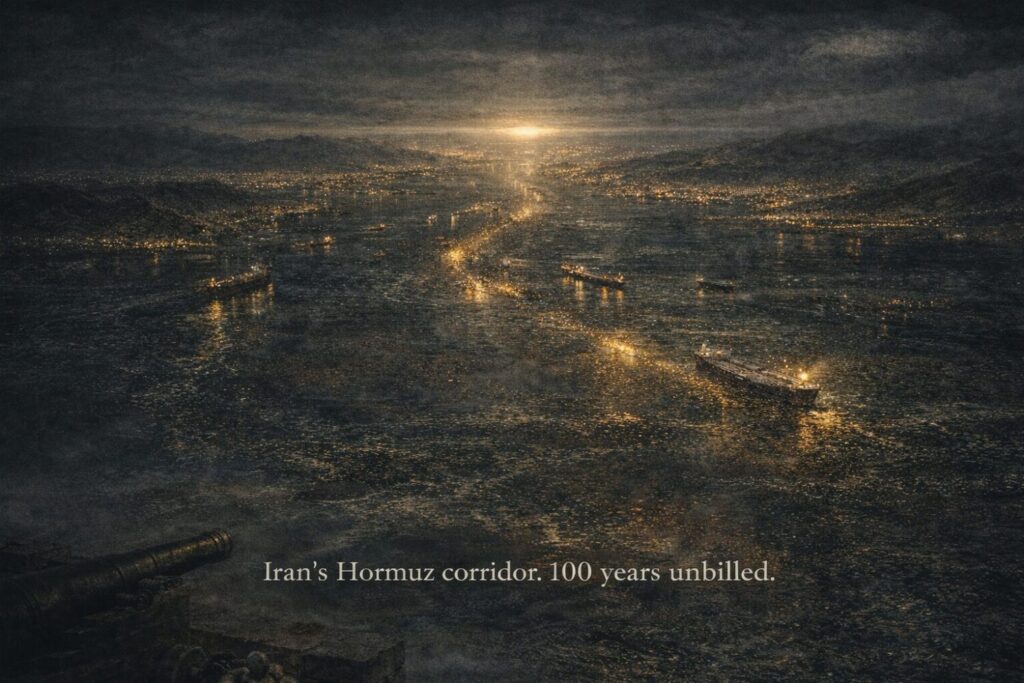
Before Iran began charging for the Strait of Hormuz, the Strait of Hormuz was charging Iran — and no one was paying.
The Toll Booth and the Cannon
The Strait of Hormuz carries roughly one-fifth of the world’s oil. Since February 28, 2026, it has also carried a price tag. Iran’s parliament has passed legislation imposing transit fees of up to $2 million per vessel. Tehran frames this as sovereign revenue. International maritime law considers it illegal. Tehran has justified the fee as compensation for the cost of war, as payment for the security Iran provides to the corridor, and as an assertion of sovereignty. This article argues that history demands a harder case be heard: a century of damage to Iran’s coastline, fisheries, and the Persian Gulf as a whole, inflicted by Western commercial appetite that extracted wealth from this corridor while impoverishing the main shore that absorbed it — and that the world has been waiting too long to read it.
The Strait of Hormuz did not become the world’s most critical energy corridor by accident. Britain extracted the first concession in 1901. America consolidated Western dominance after 1945 under arrangements the producing states had no power to refuse. Iran did not invite this traffic, design this corridor, or share in its proceeds. It has the longest coastline on the Persian Gulf, was the first target of Western extraction, and spent decades under sanctions while every legal path to compensation was closed. It absorbed the damage — poisoned fisheries, contaminated coastlines, depleted marine ecosystems, the slow suffocation of a way of life. The corridor enriched everyone who used it. For Iran, it left nothing but the cost.
Denmark did this first
From 1429 to 1857, Denmark charged every foreign ship transiting the Øresund under threat of cannon fire. It collected for 428 years and was ultimately paid to stop — by eleven European powers under the Treaty of Copenhagen, while the United States negotiated its own separate bilateral redemption. Iran’s parliament is aware of the analogy and is not discouraged by it. Iran has collected nothing for a century. The historical precedent, on this reading, favors Tehran.
The analogy, however, undersells Iran’s case. Denmark charged for territory. It had no ecological grievance, no poisoned fisheries, no century of uncompensated damage to present. Whether or not Tehran has framed it this way, Iran’s fee rests on a harder foundation: the sovereign right to charge for passage compounded by a century of destruction that passage itself caused — and the possibility that the revenue it generates might, for the first time, fund the remediation that century demands.
The price of the Strait of Hormuz
The world has only a handful of chokepoints, and each has a different arrangement with money. Egypt earns $700–800 million per month from the Suez Canal — a waterway it nationalized in 1956 and has operated ever since — charging $200,000–$300,000 per tanker. Turkey collects $250,000–$350,000 per vessel through the Bosphorus and Dardanelles. Iran is now charging $2 million per vessel for the Strait of Hormuz.
Cumulative arithmetic is clarifying. Egypt has collected approximately $150 billion from the Suez Canal since 1975. Turkey has collected an estimated $4–5 billion from the Bosphorus and Dardanelles over the same period — constrained by a treaty that has effectively subsidized global shipping at Ankara’s expense for nearly a century. Iran has collected nothing — zero. Not over the century in which this corridor was built on its coastline, and not over the postwar decades in which the modern tanker economy industrialized that burden into its current scale. Iran’s parliament has calculated that at pre-war traffic levels, its $2 million fee would generate approximately $100 billion per year — a theoretical figure, given that the blockade has reduced actual transits to near zero, but one that establishes the scale of what the corridor was worth to everyone except Iran. Over those same postwar decades, risk insurers — who border nothing, built nothing, and protect nothing — have extracted an estimated $75–$200 billion in premiums from the same corridor. Iran has never been on the receiving side of that ledger. It is now attempting to be.
What the insurers make
One beneficiary of the Hormuz crisis has attracted almost no scrutiny. Before the war, each voyage through the Strait of Hormuz cost operators $100,000–$200,000 in risk insurance premiums alone. After February 28, premiums surged to 1% of hull value at the floor — implying $10–$14 million per voyage for a large tanker, against Iran’s $2 million demand on the same vessel. Lloyds of London built nothing, is not responsible for any environmental damages, fields no navy, and has no responsibility towards the residents of the coast. It prices the risk created by others and collects the premium. The more catastrophic the situation, the more it collects. Lloyds has never been asked to justify that arrangement. Iran has been asked to justify nothing less.
What the Strait of Hormuz costs Iran
The Persian Gulf is a semi-enclosed basin whose waters renew through the single opening at Hormuz only once every three to five years. Every contaminant a passing vessel deposits stays, accumulates, and compounds — making the Gulf among the most pollution-vulnerable bodies of water on earth.
Every vessel that has ever transited the Strait of Hormuz has made a deposit. Tankers discharge oily bilge water, bulk carriers lose fertilizer precursors that eutrophicate the nearshore zones where Iranian fishers work, chemical tankers leave behind industrial solvents and persistent pollutants, and every hull continuously leaches antifouling biocides and microplastics into sediments that take years to flush. The acoustic damage is less visible but no less real — the chronic noise pollution generated by 140 vessels per day in a shallow, hard-bottomed basin disrupts the communication and navigation of the marine mammals that have used this corridor for millennia. These are not exceptional events. They are the operating baseline of a system whose cost has been allocated entirely to Iran’s southern fisheries — without negotiation, compensation, or acknowledgement.
Iran has the longest coastline of all eight Persian Gulf states, employing approximately 110,000 fishers whose yields have fallen by half in some areas within the past five years — a collapse documented by Iran’s own parliament. The Gulf’s marine life is in critical condition, with pollution levels several times higher than in other oil-producing regions and species approaching extinction.
The current conflict has layered an acute risk onto this chronic damage — one that implicates all parties, including Iran. More than 230 fully loaded tankers are now trapped in the Persian Gulf, carrying an estimated 170 million barrels of oil alongside bulk cargo holds loaded with fertilizers, pesticides, industrial chemicals, and plastics. A major spill in this basin — whose confined geography and slow renewal make it uniquely vulnerable — would devastate coral reefs, mangrove forests, and seagrass meadows for decades. That vulnerability is not a consequence of the war. It is a consequence of what the corridor was before the war: a corridor that has never once been obligated to the state whose coastline bears its cost.
Military vessels complete the picture — and compound it. Under UNCLOS (UN Convention on the Law of the Sea) the same treaty that guarantees uninhibited naval access — warships enjoy sovereign immunity and are exempt from its environmental protection provisions entirely. They burn the same fuel, shed the same biocides, and discharge the same waste as the commercial fleet — and add high-intensity sonar through one of the world’s most ecologically sensitive corridors, a weapon of navigation that the corridor’s marine life has no defense against. Not one of these costs carries a legal obligation to the state whose coastline receives them. The transit regime emerged from nine years of negotiations among 160 nations — but its transit passage provisions were shaped above all by Washington and Moscow, who needed their navies to move freely through every strait on earth. It worked exactly as designed.
A different reading
There is a different way to read Iran’s $2 million fee. Not as extortion. Not as an act of war dressed in commercial language. But as the first attempt — however crude, however legally indefensible at first sight — to price what the Strait of Hormuz has always cost and never charged for. Every sovereign that has collected money from a waterway has done so for infrastructure it built, a treaty it negotiated, or simply the force it brought to bear on those who had no choice but to pay. Denmark pointed a cannon — and collected until the world paid it to lower it.
Tehran has not framed it in these terms — but the more defensible reading of what this fee represents is something else entirely: compensation for the coastline that absorbed the damage, for the fisheries that bore the burden, for the ecosystem that was never compensated, for a century of ecological debt the current legal order has no mechanism to acknowledge. What the law calls illegal and what history calls overdue are not always the same thing.
Under a legal architecture negotiated by Britain, the United States, and the Soviet Union through the 1970s—and later codified in the 1982 UNCLOS—global access for navies and tankers was secured. Iran signed the treaty but never ratified it. Tehran also argues that its transit passage provisions cannot be invoked by states that likewise refuse ratification.
Within this framework, Iran’s fee is cast as the sole “illegal” transaction in the corridor. Not by necessity, but because the system was designed to make it so.
The same operators who absorb $10–$14 million in risk premiums per voyage as a routine cost of doing business draw the line at $2 million to Iran — not because the number is prohibitive, but for two reasons that have nothing to do with the number. The first is precedent: pay Iran once, and every nation bordering a chokepoint has a template. The Bosphorus, the Malacca Strait, the Bab el-Mandeb — the invoice queue forms the moment the first payment clears. The second is strategic: Iran collecting sovereign revenue from the corridor it has spent decades threatening to close is not a financial transaction. It is a recognition of regional power that the same governments now waging war against Iran are fighting to prevent. Whether paying Iran is the more morally coherent act than the alternative, that is to say, continuing the arrangement that built that debt is a question international law cannot answer, because international law was not designed to ask it.
The Receipt
The $2 million transit fee is considered illegal. Over a century of ecological destruction deposited into Iranian waters has no legal category at all. The law has a name for what Iran is doing. It has no name for what was done to Iran. The Strait of Hormuz has been open for business for a century. The bill has been running just as long. Iran is the first party to present it. The bill is not addressed to the guilty — they are long gone. It is addressed to those who continue to benefit. Every vessel that enters this corridor today does so on the back of a century of uncompensated damage. That privilege has never been priced. Iran is pricing it now — not billing the guilty, but billing the beneficiaries. In the long history of how empires have structured the world’s chokepoints, that distinction has never once stopped the collecting. Britain collected for decades from the Suez Canal it did not build, on labor it did not pay, in a country it had no right to occupy. The United States did not bill the guilty when it negotiated oil concessions at terms the producing states had no power to refuse. The invoice always finds the nearest available hand. For a century, that hand was Iran’s coastline, its fisheries, its people. Iran now has a valid case to ask everyone who benefits from the Strait of Hormuz to share the cost.
Behrooz Ghorbanian is a freelance researcher. Check out his website Writing Without Borders and follow him on Telegram.