The War Notes #5
Donald Trump has entered an unwanted war. Like previous American presidents, he did not design the blueprint of this war himself, rather, he has been caught in a prolonged trap shaped by Israel’s strategy. The conflict has dragged on. His estimates of the opposing forces have proven wrong. The Strait of Hormuz is closed. Sooner or later, Trump will reach a point where he can no longer claim victory, because Americans are gradually beginning to feel the destructive effects of the war on their daily lives, and effects on the economy are already being sensed by major commercial, insurance, and oil companies.
Trump does not merely have an “inner child”; his entire being embodies it. In truth, he is no more than seven or eight years old. Have you ever heard an eight year old honestly admit to losing a game and acknowledge that the opponent was stronger? Never. Such honesty requires self-awareness and an understanding of one’s own strengths and weaknesses, neither of which a child yet fully possesses. Whether he wins or loses, the narrative remains the same: I won. I’m the best. I’m faster, smarter, stronger, funnier. Trump is an enormous “I”: an ego that will likely outlive him.
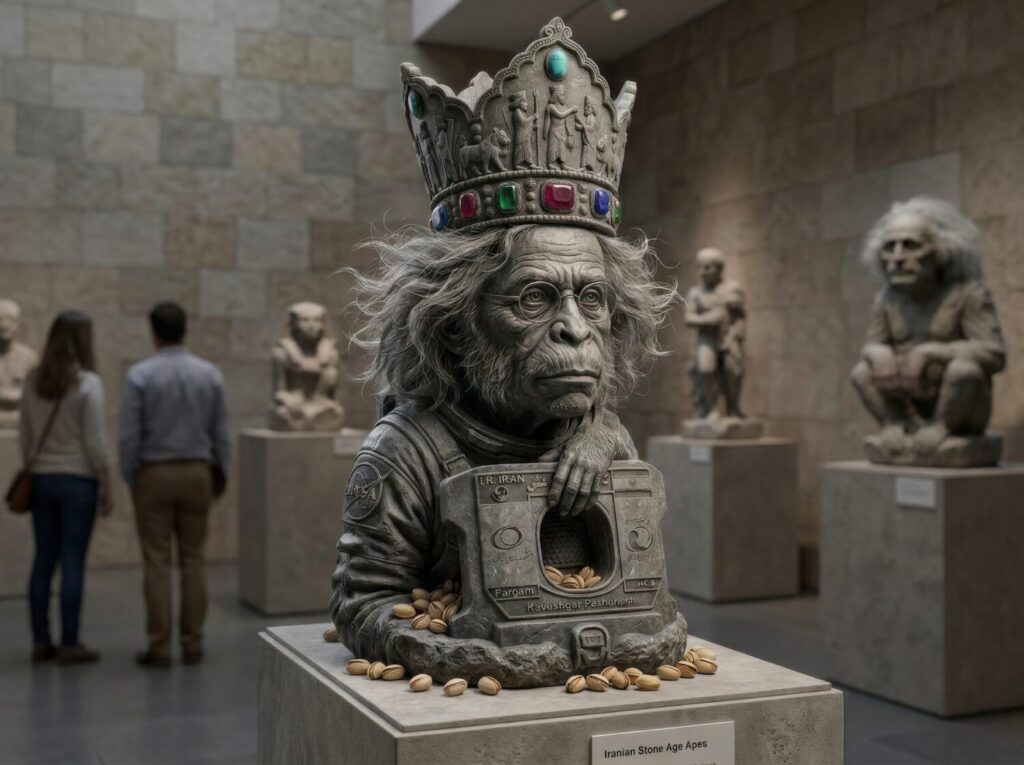
Now, this loud, arrogant, spoiled child can no longer keep repeating that Iran will be defeated today or tomorrow. So what’s left? Threats, verbal humiliation, and political bluster. In his latest rhetoric, he declared: if Iran does not yield, we will ‘bring them back to the Stone Ages, where they belong.’ These words have angered many Iranians. I do not deny that I, too, felt insulted. But I would like to look at his statement from another angle:
1. During my student years in Iran, I watched a compelling performance of The Hairy Ape by Eugene O’Neill. The story follows Mildred, a young woman from the aristocracy, who boards a coal-powered ship. In the engine room, impoverished workers toil in darkness, heat, and soot, their faces blackened by labor. The contrast between the refined upper deck and the grimy depths below symbolizes an eternal divide between beauty and ugliness, privilege and deprivation.
Out of idle curiosity, Mildred insists on visiting the engine room. When she enters, she is overwhelmed by the oppressive environment and the sight of the workers. Her attention is drawn to Yank, a powerful, rough laborer fully absorbed in physical work. Shocked and frightened by his appearance, she cries out: “Ape!”
This moment marks the beginning of Yank’s long journey toward self-awareness. The insult politicizes him; it forces him to question his identity and place in the world.
2. Eight years ago, in an essay titled “In Rejection and Longing for Nostalgia,” I argued that the West’s attitude toward us is fundamentally condescending, and that its perception of us in the Middle East is inherently biased. My criticism, however, was not directed at Western arrogance itself, but at fellow Iranians who take Western validation in the form of art prizes and imported intellectual paradigms too earnestly.
Eight years later, reality has only offered more evidence of this. OR Eight years later, reality has only offered more evidence that I was right. I regard him as a rude child. But I am deeply troubled by those Iranians who, at the outset of war, thanked him for the destruction of their own country, and by those who imagined that dismantling Iran’s political system and delivering democracy was his primary concern. Now we have his answer. He has spoken plainly. Anyone who attempts to reinterpret or justify his words is either profoundly naïve or deliberately complicit.
He has called all of us cavemen, every one of us: monarchists and reformists, those inside Iran and those abroad, the religious and the secular, officials and ordinary families alike.
3. I do not expect Trump to know that during the so called Stone Age there were no nations, no East or West. I do not expect him to know that during my time at Stanford, more than half of the students in certain fields were Iranian. It is no surprise he does not realize that Iranian talent plays a key role in the very technology companies whose platforms he depends on daily.
He cannot imagine that a heavily sanctioned nation, one that even struggles to access its own oil revenues, has managed to replicate modern technological infrastructures domestically. Nor can he comprehend that such a country has developed missile capabilities exceeding the estimates of his own Department of Defense. He does not know that a laborer in a provincial Iranian market might understand American history better than he does.
He does not know, and he does not know that he does not know: This is what we call compound ignorance.
From such a figure, with such limited knowledge and such a childish temperament, nothing more can be expected. One cannot meaningfully hate him or love him. I have always chosen to ignore him.
But I will say this again, loudly: my anger is directed at those Iranians who believe they are truly seen or valued by the West, and especially at those who expressed gratitude to Trump.
He has called us “apes.” In times like these, one must be political.
Mohsen Namjoo
April 2026, New York
Mohsen Namjoo is widely regarded as the most influential Iranian musician of his generation, an artist who has significantly expanded the possibilities of Persian music in the 21st century. Born in 1976 in Torbat-e Jam, he trained rigorously in the canon of Persian classical music before integrating it with blues, rock, jazz, and experimental vocal techniques. No other Iranian artist has so extensively broadened the emotional and sonic vocabulary of the tradition while remaining rooted in it.
Namjoo has become a prominent voice of artistic engagement for millions. His early underground recordings in Iran circulated hand to hand, building a devoted following long before exile carried him onto international stages. From Europe to North America, his concerts are acts of collective reckoning, where satire, lament, mysticism, and social commentary collide.
We at The Unsafe House had the honor to interview Mohsen Namjoo on The Unsafe Podcast, and specifically discussed his project Minooor, exploring its experimental approach and the depths of musical exploration.
This is the fifth installment of Mohsen Namjoo’s column The War Notes, written exclusively for The Unsafe Journal.