The War Notes 6 Part one
I have bad news for those curious about the current state of Iran. Iranian migrants these days fall into two groups. Reformists who have now become supporters of war and opponents of the Iranian government. And aggressive, angry monarchists who believe the goal is to overthrow “clericalism,” and along this path, any means are justified whether it be war and destruction, or even, for the first time in history, the fragmentation of Iran. And if a leader replaces the clerics, that alone is enough for him to be considered a savior whether he is a prince or even a shovel handle. Any country that attacks Iran is praised and supported, so long as it frees us from this half-century of clerical wrongdoing, even if that figure is a depraved child abuser like this one, or a corrupt, bloodthirsty fascist like that one.
Iranians inside the country, numbering in the millions, fall into three groups: the two groups mentioned above, and a third group that fundamentally supports the current political system, who, if their leader were killed, would not celebrate like the other two groups, but would pour into the streets crying out, “Alas, Ali has been killed.”
The analysis of other groups and beliefs can wait. In this piece, I want, alongside the progression of the text, to examine the mindset of the second group of migrants: the pro-war faction. I want to befriend them, understand them, and get closer to them.
The polarization of the Iranian migrant community certainly has external causes. Some believe that the idea of reviving a prince, who lost his father’s throne 50 years ago and, for most of the following 40 years, showed neither action nor interest nor a movement to return to power or play the role of a savior, is in fact the work of infiltrators tied to the clerical government itself.
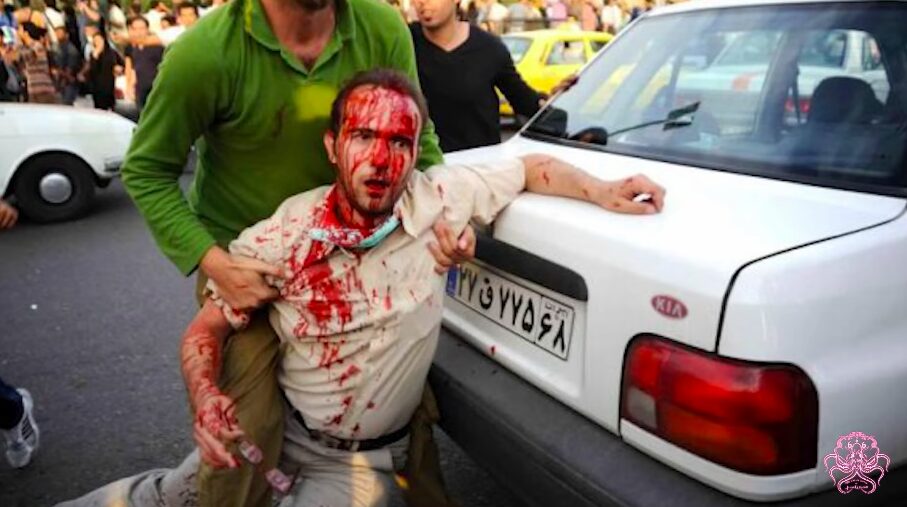
Let us remember the Green Movement, the greatest display of protest by Iranians, uniting all segments of society: educated and students, merchants and workers, poor and rich, intellectuals and ordinary people. It brought three million people into the streets in a single day. Not only was it a massive demonstration of popular power, but Iranians have not since produced a movement of that level of civility and inherently modern character. I ask non-Iranian readers to name an example, after the velvet revolutions of Eastern Europe in the 1990s, that matches the Green Movement in scale and its civilized, peaceful form. Three million people in Tehran, demonstrating in silence. Not even a single slogan containing a demand, because the substance of the demand was already clear to those in power. That day, the very form of the protest, across all segments of Iranian society, conveyed its message. No further explanation was needed.
Those who believe in a joint conspiracy between parts of the Iranian establishment and segments of the opposition explain it this way: the authoritarian and totalitarian leader of Iran truly trembled for the first time during the Green Movement. He had managed to control the rise of reformists and the student movement of July 1999. But that year, for the first time, he felt the danger of collapse.
The clear evidence lies in a few sentences he uttered in a speech after the massive protests: “I have an imperfect body… I will sacrifice it for this revolution.” He said it in a way that brought painful tears to his supporters. But he had never used such language before, nor in later movements up until just two months ago when youths were killed and he returned to the podium. He had never portrayed himself as this innocent.
Thus, believers in this theory argue that after the Green Movement, the Islamic Republic realized it had no choice but to produce and control its own opposition, both to neutralize danger and to divide the Iranian society that had shown unity during that movement.
They also present evidence for this scenario. First, a private television network is established in London, whose funding source remains unknown, even to its employees. For the first year, it does not even broadcast advertisements. It presents rare, archival footage that no one believed still existed after the revolution, shown in various programs with the highest quality and flawless presentation. For many, there was no doubt that these images could only have come from the archives of Iran’s national media, whose head is directly appointed by the Supreme Leader. A full entertainment enterprise that both weakened the state broadcaster’s market and attracted staff from other opposition media with the best salaries. And once the trap was fully set, it revealed its political idea: the “sweet world” of the Pahlavi era.
The father became the unparalleled architect of modernity, so much so that one might almost believe he had even created the famous song “Morgh-e Sahar,” or authored the poetry of Malek o-Sho’arā Bahar or the book “The Course of Philosophy in Europe” by Foroughi. And his son became the most liberal king in history.
For years, they showed images of Valiasr Street to ordinary people, and gradually accustomed them to listening to hosts like “Shadi joon,” “Samira joon,” “Siamak joon,” and “Elnaz joon,” a group whose speech was full of glaring mistakes, such as saying “armor of Imam Reza” instead of “shrine,” or mispronouncing common expressions. In the captions of their health programs, they even misspelled basic words like “anxiety.” But people were so captivated by the beautiful imagery that they overlooked these errors.
This process stretched on until, coinciding with the suspicious discovery of Reza Shah’s mummy, the first chants of young people were heard: “Reza Shah, may your soul be blessed.” The Iranian youth born after the 1990s learned everything they know about contemporary history and politics from this channel. And in this way, a need that did not truly exist gradually became real: the need for historical regression, the need for a king, the need for rapid, sweeping overthrow of the regime, without distinction between good and bad, and the harsh, vulgar mockery of those who believe in gradual reform.
Mohsen Namjoo is widely regarded as the most influential Iranian musician of his generation, an artist who has significantly expanded the possibilities of Persian music in the 21st century. Born in 1976 in Torbat-e Jam, he trained rigorously in the canon of Persian classical music before integrating it with blues, rock, jazz, and experimental vocal techniques. No other Iranian artist has so extensively broadened the emotional and sonic vocabulary of the tradition while remaining rooted in it.
Namjoo has become a prominent voice of artistic engagement for millions. His early underground recordings in Iran circulated hand to hand, building a devoted following long before exile carried him onto international stages. From Europe to North America, his concerts are acts of collective reckoning, where satire, lament, mysticism, and social commentary collide.
We at The Unsafe House had the honor to interview Mohsen Namjoo on The Unsafe Podcast, and specifically discussed his project Minooor, exploring its experimental approach and the depths of musical exploration.
This is the part one of the sixth installment of Mohsen Namjoo’s column The War Notes, written exclusively for The Unsafe Journal.