The War Notes 6 Part one
O Iranians, if you have forgotten, let me remind you: the supporters of Mir-Hossein Mousavi, after he stood honorably by his word and promise to them and remains under house arrest, turned their backs on him and now beat their chests for someone who himself once wore Mousavi’s green wristband.
Now, we can either accept the view that the “prince” is a puppet of the IRGC, or reject it. But what is certain is that this man has repeatedly poured water into the mill of the clerical government. As a supposed savior, he has not led any movement truly embraced by the masses; in fact, a couple of his calls have led to disasters like those of Dey. And as time has passed, his blunders and displays of a lack of intelligence have only added fuel to these conspiracy theories.
I want to understand his supporters, the son of Iran’s former shah and today’s imagined hope. I think it is beneath even a tiny fraction of my intelligence to do what many others do: label them as brain-frozen, foul-mouthed, fascists, or people chasing illusions, and then feel satisfied that I have “understood” them. This is exactly what they do to us. Why?
For years, I have believed that the pleasure of understanding, of emerging from ignorance, is part of human nature. When we wake up after a long sleep on an intercity bus, those first few moments, when we do not know where we are, are agonizing. When we see a math problem solved, the pleasure of it is familiar to most of us. But solving a problem requires patience and time to transform ignorance into knowledge. Our era, ruined by an obsession with speed and saving time, has made people impatient and deprived them of the opportunity to analyze. They want, in an almost impulsive and exaggerated way, to categorize the world, ideas, and people: you are either this or that. They have no patience for a third possibility.
This black-and-white thinking, let us not mock it. Let us try, as much as we can, to understand it. How do their minds work? How does someone who moved from Isfahan to Toronto just a year ago see an image of the destruction of Chehel Sotoun and remain indifferent, saying, “Well, that is one less cultural site”? How are they not disturbed that their people, existence, relatives, friends, memories, homeland, everything within it, is being humiliated and destroyed under the pretext of overthrowing one fascist by another?
How does someone who claims both the victims of Dey and “their prince” as their own, but not the victims of Minab, think? How do you follow someone who issues calls but accepts no responsibility?
Friends who support the monarchy, constitutionalists, royalists, those who raise their right hands in Vancouver in imitation of Nazi salutes, who commit violence in Canada, who attack passersby in Los Angeles, I genuinely want to understand you. Help me. What is going on in your minds that you do not see that your Donald Trump has become trapped with no way forward or back? What is going on in your minds that you place your hope for freedom in someone who, during COVID, openly suggested Americans ingest disinfectant? What is going on in your minds that you do not see the striking similarity between this foolish man, like a child trapped in old age, and that superstitious cleric who believed in traditional remedies like anbar nesa as a cure for COVID?
Would you entrust your destiny to such a cleric? Certainly not. So what is the difference with Trump? Other than the fact that he does not say “name the Strait of Hormuz after me”? He changes his words and promises multiple times a day. What has happened in your minds that you thank a president who is perhaps the most vulgar and foolish statesman in the history of the United States, indeed one of the most disappointing outcomes in the history of modern political thought since Niccolò Machiavelli?
What is in your minds? What is happening? Every day, dozens of missiles become the guarantee of your homeland’s destruction, and you still see the clerical government endure and are surprised by its resilience. What is happening in your minds that, in your gatherings, you overlook tens of thousands of political prisoners, the “Woman, Life, Freedom” movement, and all the ideals that have taken lives over the past 50 years, and reduce your slogan simply to “the Shah”? How many of you are there among these 90 million people? What about the rest?
In the time it takes to read this text, several more places have been struck. This is a homeland. This is soil. This is Iran. The very streets where you fell in love. The university you graduated from. The museum that preserves the pride of your ancestors. All the infrastructure, forests, roads, facilities, refineries, everything.
What is happening in your minds that you see a young soldier standing by a missile launcher and say, “Let him die”? What is in your minds that you cannot grasp this simple, obvious truth: that young soldier, whatever he does, whoever he takes orders from, has a stronger heartbeat for Iran than you do?
We have all suffered for 50 years from the sting of the Islamic Republic. But why is it so hard for you to understand that the antidote to a scorpion’s poison is not the venom of a snake?
Let this homeland become a homeland again.
Let it become a homeland again.
Again, and again, and again, a homeland.
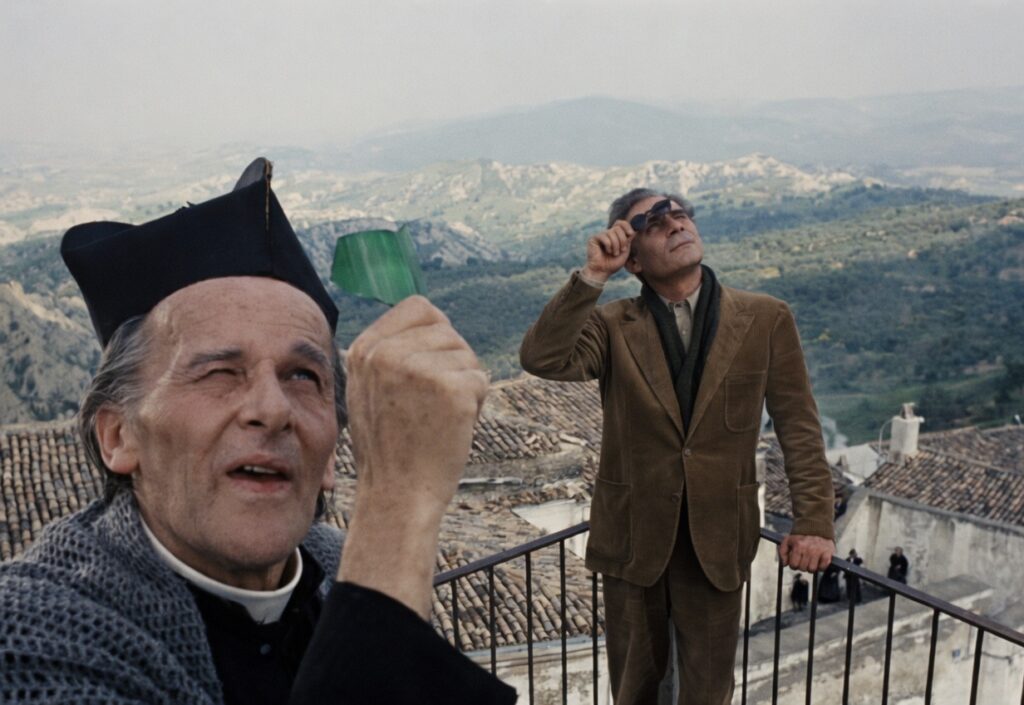
During a visit with my erudite friend Reza, who was visiting us from Washington, D.C., we reminisced about a rather obscure TV series from our past. It aired in the 1980s, the 1360s in the Iranian calendar, on television. It was a work by Francesco Rosi, featuring one of the most charismatic actors of classic European cinema, Mr. Gian Maria Volonté. Even the mention of the name’s music took me back to the joy of childhood.
The original title of the film was Christ Stopped at Eboli (Italian: Cristo si è fermato a Eboli). Eboli was the name of a remote village where the story took place. The title came from the beliefs of the people: Christ had come to Eboli but had never reached here. In other words, this region was left out of civilization, history, and even religious salvation.
The story centers on Carlo Levi, an anti-fascist writer and physician, played by Gian Maria Volonté, who is sent into internal exile during the regime. He is sent to a remote area in southern Italy, Lucania or Basilicata, where people live in extreme poverty. The government is virtually absent, and a kind of historical oblivion prevails. The meaning within the film, more than being about poverty, is about erasure and exclusion.
Francesco Rosi, in this film, does not seem to intend to be a director or storyteller in the conventional sense. He is more like an anthropologist. Unconcerned with dramatic appeal or narrative rhythm, the film is a long observation, which is what makes it compelling and enduring.
The protagonist of our story, at first, is the classic intellectual, living apart from the real, deprived, and forgotten people. This unwanted exile gradually immerses him in the lives of the villagers and fosters empathy. In this village, time is not linear. There is no progress. Tomorrow, today, and every other day feel like a closed, repetitive, and futile cycle.
The hero’s problem, before exile, was political: opposition to fascism. But here, the problem goes beyond fascism. The problem is being forgotten. The historical and prolonged structures of discrimination and injustice are at play. This village symbolizes a world that history has never reached, a portrait of the complete erasure of everything, even hope.
Iranians who love the past are not uniform; they are highly diverse and multifaceted. But before reviewing that, I must say that the other side of the story is this: our hatred of ourselves, of what we are. Countless talented Iranians, through intelligence and hard work, come to the West for the highest levels of education. They excel in Western universities. They take on the most prestigious positions in fields where the language they work in is not their mother tongue.
Yet, at a party, when an American utters a single word in Persian, they react with such excitement as if the American were the genius and they were not. Or we have seen football coaches who have worked 15 years in Iran, and at a press conference, when asked if they will win the next game, they simply say, Inshallah, and the room erupts with delight.
What superiority does this Western individual have, who after 15 years still cannot buy a sangak bread in Tehran for themselves? And we fail to see these things because we suffer from a lack of self-esteem. It is as if the Persian language itself has an intrinsic weakness, and no one is supposed to speak it except us. Why? While we boast about our past, which we know is hollow, we lack the courage to express or even confront this reality. And anyone who points out this emptiness and weakness, first we metaphorically “bite their throat,” and then we isolate them, as has happened with the author of this text.
Because our present is weak, we respond in two ways:
- Pride in our illusory past.
- A thirst and intoxication for Western validation.
The essence of this contradiction forms our existence. In fact, the second response is done precisely because we are aware of the falsity of the first.
Another manifestation of our imitation of the West is that all celebrities want to be philanthropists and benefactors, which has two problems. First, in its nature, it is hypocritical and self-promotional. Second, the very Western idea of altruism was undermined over a century ago by one of the most biting critics in history, Nietzsche. Which Western artist in history has even played sitting volleyball? Why, instead of imitating all these Western appearances, do we not learn from Caravaggio?
Ideas and concepts such as progress, innovation, and being up to date must themselves be reconsidered because they are imported values.
Let us, setting aside moral or emotional disputes, turn to a fair and nonjudgmental analysis of the lovers of the past. Certainly, they are not a homogeneous group:
- Direct beneficiaries of the past
These are people who held special positions, wealth, prestige, or security in the previous power structure, family, networks, jobs, promotions. For them, nostalgia is not memory; it is a defense of lost interests. They usually talk about order and stability, mention less about freedom, and consider historical accountability a form of grudging spite. This group is not entirely sincere, but their logic is understandable, because they are defending themselves, their class, and their history. - Those fatigued by ideology, former leftists, former revolutionaries
For them, the past is more a psychological refuge than a political choice. They are tired of the moral cost of always being righteous. Their mindset is: if we had not thought so much, read so many books, maybe we would not be here. The danger of this group is that they mistake fatigue for a suspension of criticism. They are weary and disgusted by the failure of idealistic projects and the betrayal of intellectual leaders, most recently the reform movement. They are neither monarchists nor supporters of authoritarianism, but they see no other choice. - Victims of the Islamic Republic
People who have lost loved ones, experienced exile, and suffered injustice. When they say “Long live the Shah,” they are often not calling for the Shah but shouting “No to the mullahs.” This is a human reaction, not a political analysis. The problem is that pain, if not transformed into a plan, can push us back into the embrace of tyranny, though under a different flag. - Consumers of media nostalgia
A younger generation who did not live through that era or only saw selected fragments through politically slanted media: clips, music, clean streets, stylish women, men in ties. Television has turned the past into an Instagram filter for them. They do not see prisons, SAVAK, discrimination, or marginalization. They are more in love with the image than the history. - Right wing authoritarians
People who truly believe that society cannot advance with freedom. They think people are not ready and that democracy is too much of a luxury for countries like Iran. This group is small. They would accept any centralized power, not just the Shah. Their concern is not the name of the ruler but control.
Naturally, none of these groups can be reduced to a single label. What they share, however, is this:
Nostalgia is not an answer; it is a signal.
A signal of wounds, fatigue, anger, or class and professional interests.
Some people should be understood.
Some should be critiqued.
And some should simply be kept at a distance to preserve our own well-being.
The fatigue of recent years is real, the exhaustion of explaining the obvious to those who want to simplify everything. I wish there were words that could be both reasoned and boundary setting, so that we would not have to enter exhausting debates. I am tired of mocking Iranians who, in Berlin, play the Victory of History anthem, their illusions reduced to ridicule. I want to understand them. What can my response be to today’s “Long live the Shah” chants and political nostalgia?
My issue with the past is not remembering; it is mythologizing. Nostalgia becomes dangerous when it replaces analysis and edits collective memory. When suffering is erased, structures are sanctified, and a polished image takes the place of complex history. That people with deep disagreements have agreed on a slogan is not a sign of political maturity; it is a sign of fatigue. Fatigue from the disastrous present pushes a person into the arms of any past, even one built on despotism.
My problem is not that someone speaks of monarchy. My problem is that “Long live the Shah” is presented as the answer to everything:
without accounting for power
without critiquing concentrated authority
without guarantees of freedom
without mechanisms to prevent dictatorship
If we are to speak of the future, why do we speak in the language of glorifying power?
If we speak of freedom, why do we seek shelter in a structure that understood liberty as top down charity?
If we speak of human dignity, why do we immortalize names while human rights remain temporary?
Television can create images, feelings, even memories, but it cannot create truth. Truth comes from the clash of narratives, from acknowledging wounds, and from historical responsibility. No society has been freed by erasing parts of its memory. I do not want to fight anyone. Our battle is not with each other; it is with simplification. With the dangerous idea that one name, one family, or one beautified past can serve as a savior.
Freedom is a project, not a relic. The future requires a social contract, not nostalgia.
If there is to be any agreement, let it be this:
No power is sacred
No name is beyond critique
No past grants a license to repeat tyranny in the future
Mohsen Namjoo is widely regarded as the most influential Iranian musician of his generation, an artist who has significantly expanded the possibilities of Persian music in the 21st century. Born in 1976 in Torbat-e Jam, he trained rigorously in the canon of Persian classical music before integrating it with blues, rock, jazz, and experimental vocal techniques. No other Iranian artist has so extensively broadened the emotional and sonic vocabulary of the tradition while remaining rooted in it.
Namjoo has become a prominent voice of artistic engagement for millions. His early underground recordings in Iran circulated hand to hand, building a devoted following long before exile carried him onto international stages. From Europe to North America, his concerts are acts of collective reckoning, where satire, lament, mysticism, and social commentary collide.
We at The Unsafe House had the honor to interview Mohsen Namjoo on The Unsafe Podcast, and specifically discussed his project Minooor, exploring its experimental approach and the depths of musical exploration.
This is the part one of the sixth installment of Mohsen Namjoo’s column The War Notes, written exclusively for The Unsafe Journal.