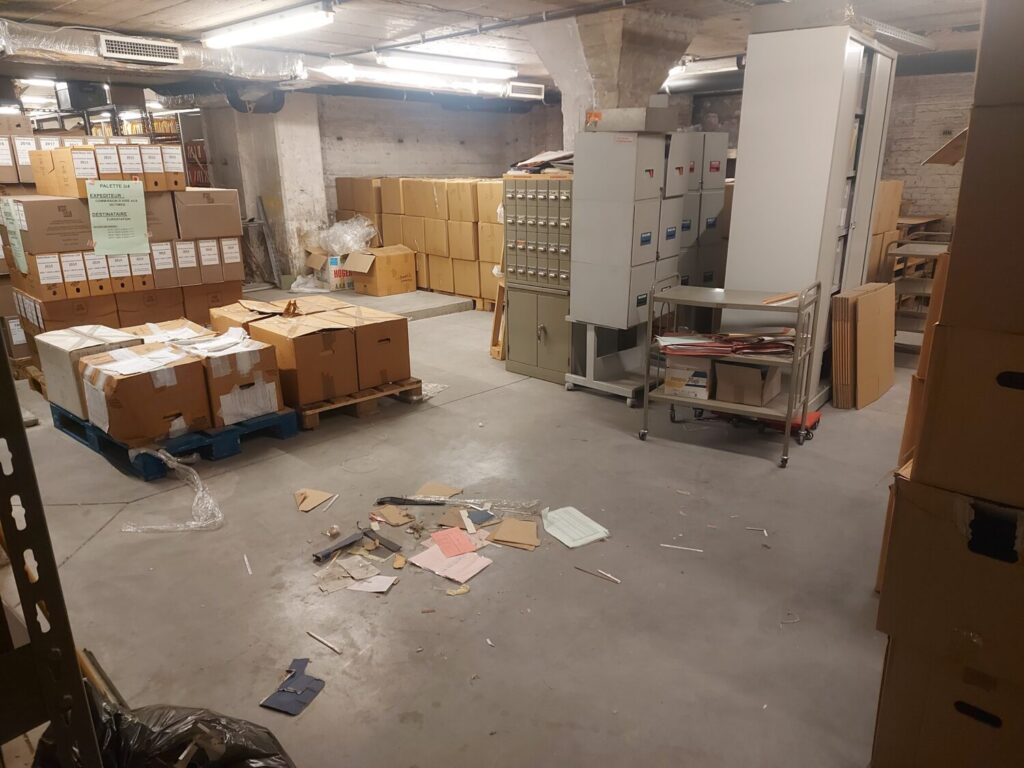
Just imagine. You’re in an underground storage room. It must be part of a labyrinth. There’s nothing but filing cabinets and boxes stuffed with paper on shelves or pallets, filling the whole space with a slightly sour, musky odor. Not a sound to be heard, no one else in the area. Look at the picture above. What do you think, do you like what you see? Some hopeless romantics may feel attracted to a dusty ambient environment with few people hanging around. Still, most of you probably won’t want to stay here for very long (although you can never tell with the audience of The Unsafe Journal). But virtually everyone will admit: “I’ll be damned if I’m going to clean up this mess.” And that’s where I come in.
I like these spaces, my daytime instincts draw me towards them. This is the biotope of an archivist. As for the image above, I can tell you that my work is starting to pay off. You may not notice it but the order of things is slowly returning, everything is falling in its right place. Compare all the information in this room with a brain. Over a year ago, retrieving a specific file or document was nearly impossible. You might say that whoever tried doing so would act like a person suffering from dementia: hopelessly stumbling around, randomly opening boxes to close them again and to repeat the same gesture over and over, before finally leaving empty-handed as well as empty-headed. In case this makes you smile pitifully, do you think the digital world is any better? Do you have a clear view of everything stored on your laptop or Smartphone? I’ll be damned if I’m going to clean that mess up.
But whether they come in the form of cellulose or as bits and bytes, archives are best understood in biological terms. Administrations act as organisms and archives are the result of an organic process, the outcome of an organization’s daily activities. Even in a virtual environment the analogy holds up. Bit errors during data transmission must be the digital equivalent of DNA replication errors. Sclerosis inevitably kicks in and hard discs can crash just as fast as a human memory. The idea of a ‘document life cycle’ is of utmost importance: regardless of how you store it, information ages. Archives are like crops, they have their season. And when I enter a storage room like the one above, I come to harvest. With a proverbial scythe at the ready, I separate the wheat from the chaff. Roughly 80% goes down the drain, the remainder is up for permanent conservation. I am not a passive agent, I do not settle for the role of innocent bystander. Like a forest ranger trimming the trees, a dentist extracting bad teeth or a medic cutting into body parts, I leave my mark. And we call it… appraisal.
Ironically, in spite of all these biological metaphors, the only ‘medium’ or storage device out of my reach is the human body. That’s the domain of other specialists. Perhaps torturers are the ultimate archivists? Their business is to extract information from the most delicate, unreliable and stubborn anatomical matter. Likewise, the State has reserved the appraisal of human bodies for other actors: snipers, generals, bombers and the like. They get to decide when people can be dispensed with, when they have served their use (if ever there was any). They can be really thorough. Does it smell of jealousy here? Experience has taught me that archivists would also be perfectly capable of doing these things… amongst themselves to begin with. Man never runs out of prey. Fortunately, the democratic legislator has understood that an archivist needs to be firmly chained in some underground storage room or near a server park to reach peak productivity. One can quickly tell whether someone is suited for the job. As my superior says: lock the candidates up in a repository for a day or two. Either they thrive or they turn green. In the second case, they better leave. Not everyone can play the part of Hephaistos.
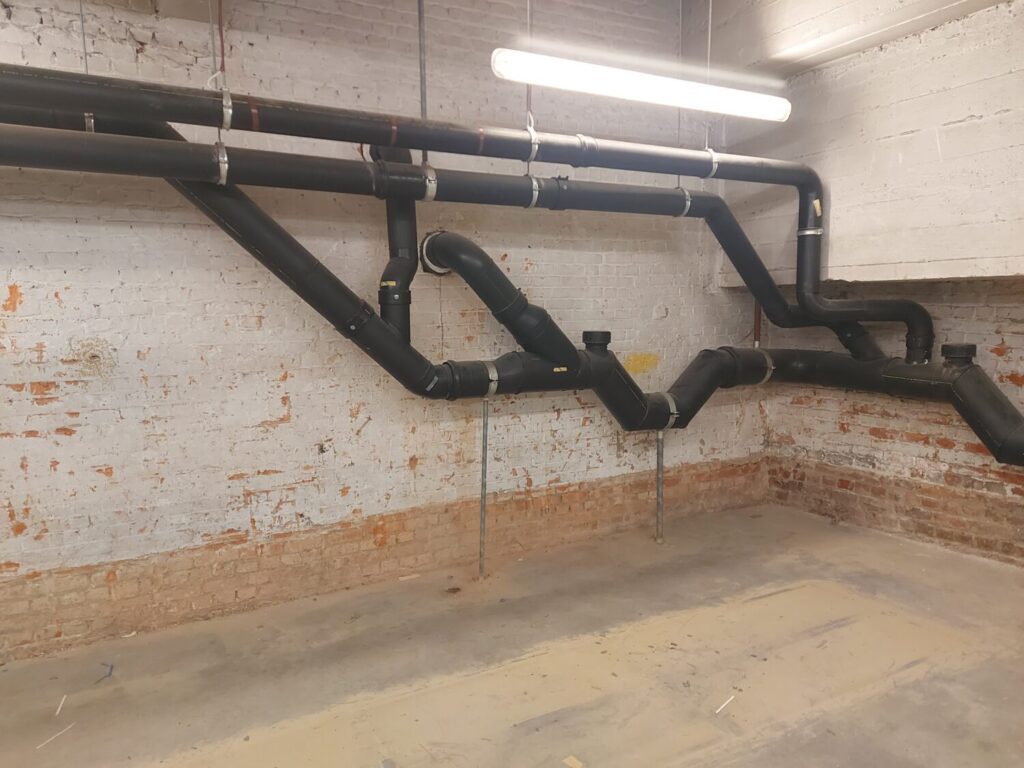
I digress. The water coursing through the basement tubes calls me back to my work. It’s probably toilet water I’m hearing. The noise is reassuring, the content stays neatly within the pipes. If not… Yes, I’ve been there once and I will not enter into detail. Regardless of whether it contains minerals and metabolic waste products of human origin, water is the mortal enemy of paper documents. It’s funny how popular imagination tends to associate the loss of archives with the very opposite element: fire. True, infernos are spectacular to behold and they can punch nasty holes in the collective memory. Brussels provides us with a notorious case: the firestorm in the former Ministry of Public Education back in June 1947. A hot summer’s day and a local energy plant on strike meant the employees in the basement had to be creative to see where they were going. But striking a match in a corridor filled with highly flammable nitrate films was probably not a bright idea. Quentin Tarantino invented nothing when he screened a pile of these movie reels being set on fire. Some inglorious Belgian bastard had been there long before.
Popular opinion also associates burning archives with another violent phenomenon… war. In the past, some local administrations ran out of luck when facing an artillery barrage or an aerial bombardment. But these are exceptions. War as a destructive force in the world of archives? Quite the contrary! Mars, the bringer of war, the catalyst of record creation. When a country goes to war, imagine the effort required for planning military operations, mobilizing forces and coordinating the actual fighting. Tons of paper and terabytes of data are generated, all the way from the political decision-makers to the central military command and the units on the battlefield. Multiply this by the number of bellicose nations. Meanwhile, behind the screens, the diplomatic world buzzes like a beehive. And when the dust finally settles, there’s an even bigger pile of work awaiting : punishing collaboration, rewarding resistance, getting the economy back on track, stabilizing the budget, coordinating reconstruction works… And that’s just the State apparatus. The outer world acts even more frenetically: news coverage, articles, books, blogs, pamphlets, discussion forums, AI imagery, etcetera, etcetera. You need proof? This very journal features quite a few reflections on recent wars, tiny ripples in the outer rims of these conflicts.
No, you can’t scare archivists with fire and brimstone. Water is our biggest fear. Because of its “summoning power”, water attracts the tiniest of scavengers. Not just rodents or insects for whom an archive repository is the equivalent of a three star restaurant, but far worse: micro-organisms like moulds and fungi. Those pale, shapeless entities that only excel at replicating themselves while sucking the energy out of their environment. They are mother nature’s communists. They start thriving at any temperature above zero and they are treacherous. They can be airborne and infect documents even when the naked eye doesn’t notice their presence. Air, heat, moisture: water makes the other elements work against the archivist, as if nature wants to reclaim its raw materials. And we can’t let that happen, now can we?
It would appear then, that an archivist’s work is quite unnatural, in spite of all the biological metaphors and analogies that were drawn earlier on. What else could it be but a human endeavor? The domestication of the natural flow of time, the fight against oblivion. Is the archivist one of the lords of the collective memory? If so, he would occupy a more elevating position instead of gathering dust below the ground floor. Is he more of a farmer then, someone who fosters society’s past? But the archivist doesn’t sow or raise anything. He merely reaps what others have cultivated. Moreover, the storage capacity he liberates will be replenished again. The archivist looks like a creature trapped in a never-ending cycle of ebb and flow, not quite an eternal recurrence of the same but rather a continuum of the very similar. A human mimicry of natural development. Natura non enim nisi parendo vincitur. Did I compare the archivist to Hephaistos? Perhaps he is more akin to another figure of Greek mythology: Sisyphus, the cheater of death whose punishment was to roll a huge boulder endlessly up a steep hill. In one of his early writings, Nietzsche offers us the most original (and unlikely) take on the etymology of Sisyphus’ name: “The tasting one”, the man with a selective judgement based on the most delicate sense of flavor. Nietzsche reserves this characteristic for philosophers, but shouldn’t it apply to archivists as well?
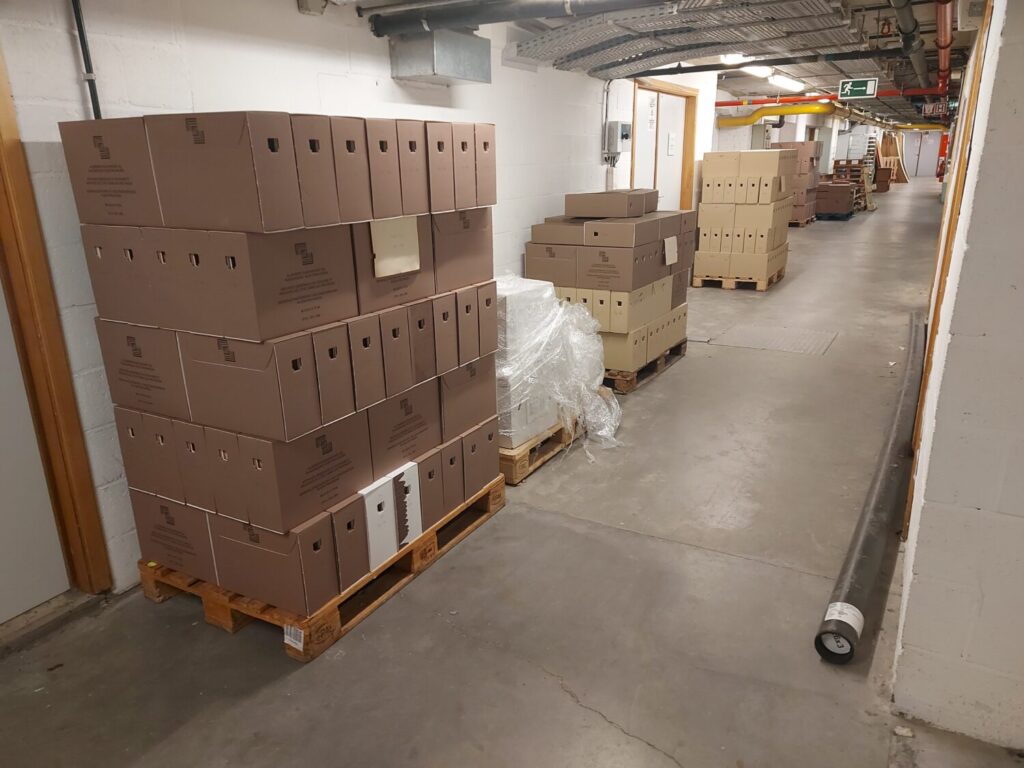
“Let’s imagine Sisyphus to be a happy man”, wrote Albert Camus. Suits me fine. I enjoy the physical aspects of my work. I’m always on the move, I achieve tangible results. I prefer it a hundred times to a desk job and sitting in front of a screen all day. This Sisyphus isn’t alienated by his labour at all, Karl Marx will have to recruit his revolutionaries elsewhere… I smile when I recall how a retired colleague used to describe his work on linkedIn: “Cramming old paper in new boxes”, an insider joke based on the old cliché that archiving is just “much ado about shelving”. I don’t mind shelving. Carrying boxes around all day feels pretty much like jogging. While the body is kept busy, the mind is free to wander. I’ve come up with interesting philosophical questions and insights in places like this. I’m going to miss its vibe. From what I’ve heard, this building will soon be turned into a hotel and these very rooms should be converted into… a fitness center! It takes just a few steps from lifting cellulose to pumping iron. I wonder: should I play along and visit these future facilities as a hotel guest? Probably not. I would only feel disenchanted, like a priest walking in a deconsecrated church. Or better still: like a shaman catching intruders on his ritual ground. Ah, as if the average mortal would care. By now, even the reader’s patience may have worn thin. “What do your taste and sensibilities matter to me?” (s)he will say. “Be on your way, you subterranean crawler!”
And yet, not all is done and said. My work may be of interest. Not because of how it makes me feel, but because of the fruit it bears. All of the above is only phase one of a larger process. Once I’ve ploughed through storage rooms like these, the archives that survive my tasteful judgment will face an afterlife. They shall be transferred to a repository and await their reincarnation. Food for thought, notes for a second chapter…
Nukem 101 – A creature from the underground. One of the worst of a bad lot. Fast, hard to kill and able to either burry or resurrect the dead. A parasite living in the bowels of philosophers, but if they’re strong enough they won’t mind. Enough said.