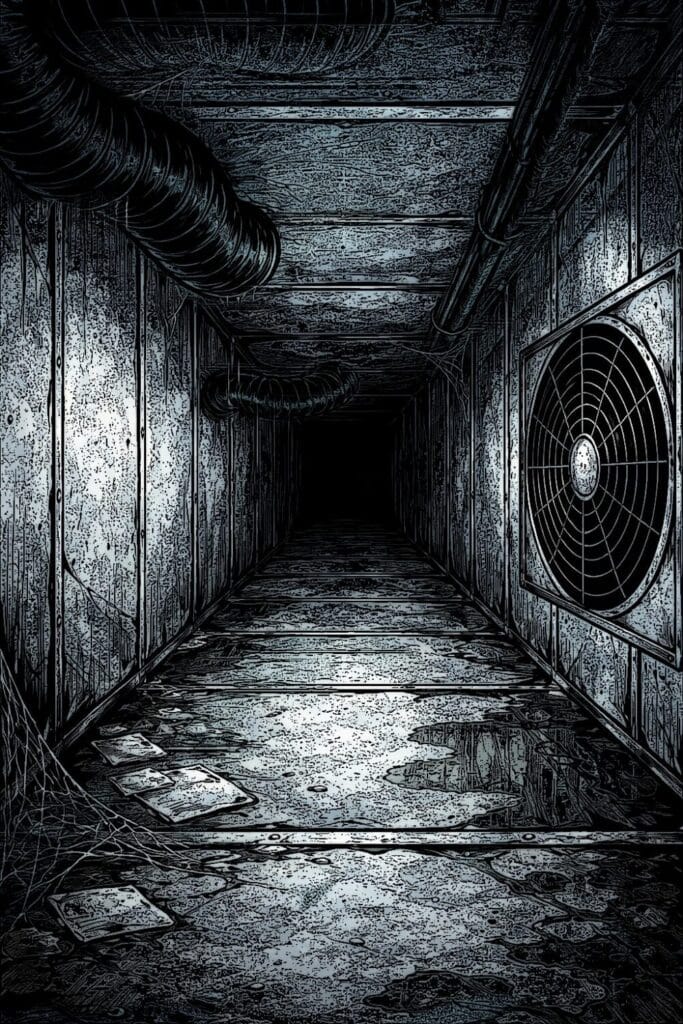
“No, you don’t quite get it yet,” says Hartmut, his voice echoing in the cold, narrow shaft. “Being itself cannot be a being. It must lie beyond all beings, because it is what creates the difference in the first place.”
His words branch out in my brain and in the acoustics of the air shafts that run behind and in front of us through the hotel.
“You know what?” I say, “I think all these philosophers were only ever concerned with God!” I have to say this now, trapped for days in the air conditioning shaft of the expensive hotel, slowly feeling my strength ebbing away.
Since yesterday, we’ve been discussing nothing but existential philosophy because we’ve now come to terms with our own existence. We had been shouting and knocking for almost a whole day, then we realized that no one was going to respond. I can’t blame Hartmut for wanting to see if all the air duct crawling from the movies works in real life. That’s what happens when you share a room with Hartmut, have a lot of time and a little boredom, and are constantly staring at that flap in the corner of the wall.
We really got far into the shaft system. At one point, it smelled like turkey breast and fresh pan-fried vegetables from the hotel kitchen below us, and we seemed to have passed the laundry room. But eventually we came to a spot where the shaft sloped slightly downward and the square pipe narrowed. We got stuck. Since then, we haven’t been able to move forward or backward. And for the first time, I’m not just listening to Hartmut, I’m showing him.
I want him to understand that I’ve admired him all along for his studies and his ideas. I also want him to realize how many of these existential thoughts I can relate to, even though I just lie in the bathtub and play PlayStation all the time.
On the second day, we started talking about philosophy. We began with the Enlightenment, Kant’s categorical imperative, and disinterested pleasure. Echoing through the narrow metal shaft, we discussed Hegel’s concept of the world spirit and Schopenhauer’s The World as Will and Representation, as well as a little bit of antiquity and Hobbes’ frightening Leviathan, in which man is a wolf to man. “God is dead!” Nietzsche’s words finally echoed through the pipes, and at one point Hartmut quoted aloud and crisply an entire passage from Wittgenstein’s Tractatus, that linguistic-philosophical monster that even professors don’t really understand, but only sense in its enigmatic nature. That was, I think, on the fourth or fifth day, and Hartmut’s voice already sounded pretty crazy, as if he wanted to shout: “So this is where all philosophy ends, I’m stuck in a shaft and can’t get out!”
Now it’s slowly coming to an end, I can feel it, and we don’t have many philosophers left.
“Basically, it’s always about the feeling that there’s more behind everything,” says Hartmut.
“But you don’t know exactly what,” I say.
We breathe again. It sounds like metal.
“Hartmut?” I say.
“Yes?”
“I think I understand.”
“Good,” he says, and he means it.
*
When I walk through the institution now, wheeling my patients along in front of me, I sometimes think about the time in the shaft with Hartmut. Of course, he has already become a ward nurse; he just has a quicker grasp of things. I think it’s great how he deals with the patients. He engages with them completely, listening to their theories and delusions, all their stories, however confused or ingenious they may be. Hartmut doesn’t really see them as mentally ill. How could he?
The hotel was already sealed off when we crawled out of the shaft. It’s amazing how long a person can survive when they’ve almost given up. At some point, we got thinner and could fit through the shaft again.
In the corridors of the hotel, we found men in suits sitting on the floor, babbling and staring at the baseboards. Others were twitching, as if they simply wanted to continue their work but were being held back by something that kept pulling them back. Some of them were captured and gently led away.
There was a hospital scent in the air, which had replaced the typical hotel smell of fresh bedding, soap in small packages, and carpets that always smelled new.
“What’s going on here?” we asked a man in a white coat, completely bewildered.
“Yes, haven’t you noticed?”
“What?”
“The thing with the voices?”
We looked at him silently.
“Be glad you didn’t hear them. They came from everywhere, out of the walls. For days. I don’t know what they must have said, but it even affected some of my colleagues, the experts who were the first to arrive here. Almost everyone in this hotel has gone mad. We can’t take them all to the clinic, so we’re bringing the clinic to the hotel. There are enough beds and rooms.”
A few months later, we signed on as nurses and were quickly promoted when they saw how amazingly well we could deal with the kind of madness that had afflicted hundreds of bankers, trade fair visitors, normal hotel guests, and staff during that mysterious week.
It had started in the kitchen, when the cooks preferred to philosophize about the ingestion of the world through the mouth rather than cutting vegetables and salting soup. Cleaning ladies meditated in the mountains of laundry, and bellboys grew mustaches and talked about the will to power.
The lady at the reception desk answered questions about directions with sentences like, “Who can know where we are really going?” and the hotel manager rambled on about how the world spirit reveals itself in people through the principle of luxury. The guests were affected after one night at the latest, when the whispers rose from their subconscious like heartburn and made it impossible to continue their work at the trade fair.
“Break?” asks Hartmut, who comes out of the kitchen with a coffee cup and has officially become my boss.
“Yes,” I pant, as if I had been lugging packages around like I used to.
Then he pulls me into the kitchen, pushes a piece of cheesecake over to me, opens the newspaper, and engages in small talk about the latest headline.
For twenty years and with more than sixty titles, Oliver Uschmann & Sylvia Witt have been enriching the book market with satirical literature, young adult novels, and narrative nonfiction. They have even turned their best-known book series, Hartmut und ich (Hartmut and me), into a habitable theme park. As ghostwriters, they occasionally lend their voices to others. In the visual arts, Sylvia Witt makes her mark with her incomparable style.Always searching, only one thing is certain for both of them: God is not dead.