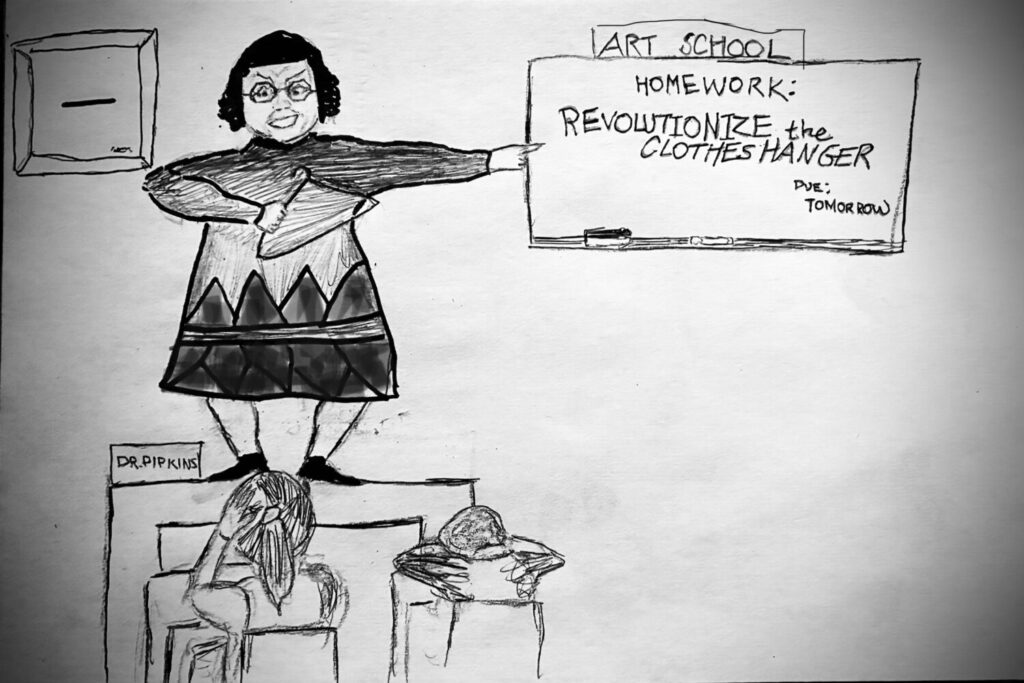
Dr. Mildred Pipkins would have had a bad day were it not for the letter she received that evening. It was the day of the Buckstaberry Art Academy’s annual staff awards ceremony. From the moment she woke up, she tried not to think about the ceremony.
Dr. Pipkins started the day as any other. She woke up three hours before she had to be at Buckstaberry because she liked to drink a whole pot of black tea before her first class. Sitting in her kitchen in a pink robe and slippers, she would refill her little rose-patterned teacup about ten to twelve times over the course of an hour while staring at her white and blue paisley wallpaper. This was her meditation hour. She needed to empty her mind like this every morning in order to present her students with her best possible performance. It felt especially important today, on the day of the ceremony, but again – she tried not to think about it.
“every daily activity should be performed beyond its average duration, ideally to the point of doubling its duration, so as to transcend the activity itself and transform it, over time, from task to experience, and finally from experience to philosophy.”
Once her mind and the teapot were sufficiently drained, Dr. Mildred Pipkins would then put three eggs in a pot of cold water, turn on the stove and set a timer for twenty-one minutes. She would spend those twenty-one minutes at her desk in the living room where she had a copy of Dr. Seuzel Buckstaberry’s seminal and unparalleled work, Shaping the Artist of Tomorrow. Dr. Seuzel Buckstaberry had spent decades accumulating data on the creative development of artists and, through those datapoints, had identified seventy-three methodologies for developing artistic ingenuity, which he condensed into seventy-three lesson plans. This came to be known as the Buckstaberry Method. All professors at the Buckstaberry Art Academy were required to follow the Buckstaberry Method. It was the most peer-reviewed and thoroughly tested-method for developing revolutionary artists.
Dr. Mildred Pipkins was not just a follower of the Buckstaberry Method. No, she was much more than that. Dr. Mildred Pipkins lived and breathed the Buckstaberry Method. Take her morning eggs as just one of countless examples: on page forty-nine, note three, Dr. Buckstaberry remarks that “every daily activity should be performed beyond its average duration, ideally to the point of doubling its duration, so as to transcend the activity itself and transform it, over time, from task to experience, and finally from experience to philosophy.” Dr. Pipkins thus cooked her eggs for a little over double the time they required to be hard-boiled, so that they would come out tough, rubbery, and grey. Dr. Pipkins ate these eggs each morning with considerable displeasure, thus transforming a simple task into a challenging experience. The experience, which she had endured every morning for the past year, had not yet transformed into a philosophy, but with a little patience she was certain such a transformation was imminent.
What would she teach her students today? She asked herself. Dr. Pipkins turned the page of Shaping the Artist of Tomorrow to lesson sixty-two: “Revolutionize the Clothes Hanger.” Ah yes, one of her favorites:
62. REVOLUTIONIZE THE CLOTHES HANGER

The artist is to revolutionize the clothes hanger. The artist is to accomplish this without tools or manipulation of the clothes hanger. The artist must conceive of a completely new identity for the clothes hanger. The artist is to revolutionize the clothes hanger overnight. A passing mark will be given to those who develop a new use for the hanger, while the highest mark will be awarded to those artists who make the professor regard the hanger in a radically different way.*

*Offensive or violent uses developed for the clothes hanger will be given a failing mark.
Taking a deep breath, Dr. Pipkins recited these five lines to herself over and over, immersing herself in their poetry. True, in the fifteen years she had been teaching at Buckstaberry Art Academy, no student had ever convincingly revolutionized the clothes hanger. They may have concocted new uses for the clothes hanger, such as employing it to stipple bread dough, but a new use was not necessarily a new identity. So far none of her students had made her see the clothes hanger in a “radically different way.” Maybe today would be the day! And maybe then she would earn an award at the ceremony.
The timer went off. Dr. Pipkins returned to the kitchen to peel her eggs. She tossed them from hand to hand under running water and laid them out on a sandwich plate. Then she picked up the first one, blew on it, and ate half of it, without salt or pepper. The texture was like silicone. She stared at the wall, chewing and chewing until all three eggs were eaten.
Nestled comfortably behind the wheel, Dr. Pipkins drove to work, passing a Mr. Muffin drive-thru along the way. The mere sight of the Mr. Muffin sign, a large blueberry muffin wearing a chef’s hat towering over the four-lane road she took to Buckstaberry Art Academy, triggered an overwhelming reaction in Dr. Pipkins. She could not help but switch on her turn signal and veer into the Mr. Muffin drive-thru.
‘Hello, yes, one triple chocolate fudge peanut butter muffin top, please!’ Her favorite.
‘What size?’
‘The Mega-Muffin.’
‘Please pick up your muffin top at the window.’
Dr. Pipkins took the muffin top from the man at the window with both hands, then pushed it out of the bag just enough so that she could nosh on it while driving. It was the one part of the day that Dr. Pipkins did not live according to the Buckstaberry Method.
She ate the muffin top with gusto, imagining herself to be Pavarotti eating steak and pasta before performing as Cavaradossi in Tosca. Yes, she needed a full stomach to perform well. With her belly full of muffin, Dr. Pipkins breathed in and out as the bell rang and students swarmed the hall, trickling into her classroom and sitting behind their desks one by one. When the last one entered, she leapt onto the desk just as she had practiced countless times in years past.
“REVOLUTIONIZE THE CLOTHES HANGER!” She shouted, thrusting a wire hanger into the air. “Turn the familiar into a total stranger! Transform it until you’re staring at your closet screaming, I DON’T KNOW YOU ANYMORE! Questions?”
“Can we reshape the hanger?”
“No physical manipulation of the object will be permitted!”
“Can we use wooden hangers?”
For a split-second Dr. Pipkins paused to think. If they used wood they might use paint, and paint, the most unrevolutionary of mediums, was certainly not allowed at Buckstaberry Art Academy. “Only wire! And violent revolutions are absolutely forbidden!”
The students came and went. After each bell Dr. Pipkins leapt onto her desk again, mustering all the enthusiasm she could from her triple chocolate fudge peanut butter mega muffin top. By three PM she was exhausted and, unusually, discouraged. She didn’t have the feeling that she was able to incite a revolutionary fervor in any of her students that day. None of them looked particularly inspired, least of all those who were sleeping.
Dr. Pipkins pushed the negative train of thought out of her mind. As Dr. Seuzel Buckstaberry wrote, “one of your students could be the next Duchamp.” Duchamp often did look rather blasé, she reminded herself. Who knew what was going on in those minds…
“…she imagined her car crashing into it, the giant muffin teetering over and collapsing over the top of her Honda.”
It was unusual for such thoughts to intrude on Dr. Pipkins’s fearless optimism. But she was very well aware of the reason for their intrusion. After her last class had ended, Dr. Pipkins made her way to the assembly hall for the awards ceremony. With each passing year she dreaded the awards ceremony more and more. In her fifteen years at the Academy, Dr. Pipkins had never been granted a single award. She had never even been nominated. For ten years she bit her tongue, conceding that she still had much to learn. But by now she was all but certain that she was the most dedicated and dogmatic practitioner of the Buckstaberry Method at the Academy; indeed, she would even venture to say in the whole world. The teachers who were nominated and granted awards were all – she hoped she would be forgiven for thinking this – uninspired. No jumping on desks, no shouting, just droning on and on, their consonants blending with one another to form a verbal soup which was sure to lull students to sleep. Above all there was no interpretation of Buckstaberry’s brilliant prose. And to add insult to injury, whenever one of them won, they never had a speech ready. Dr. Pipkins, meanwhile, arrived every year with a prepared speech. She would prepare it weeks in advance and rehearse it over and over, just in case she won. Maybe tonight would be the night!
The drive home after the ceremony was dark and silent. Dr. Pipkins clenched the wheel and stared straight ahead. She fought the irresistible urge to slam the gas pedal and roar down the road. As the Mr. Muffin sign loomed in the distance, illuminated by an adjacent street lamp, she imagined her car crashing into it, the giant muffin teetering over and collapsing over the top of her Honda. The Academy would have to acknowledge her accolades then. In the weekly bulletin after the accident, they would finally recognize her for the brilliant Buckstaberry Method expert she was. Maybe they would even name an award after her. Maybe they would shower her with posthumous awards.
She drove past the Mr. Muffin without incident. About ten minutes later she was at the foot of her driveway. She rolled down her window to open her mailbox. There was a single envelope which she picked up and dropped onto the passenger seat. After parking the car in the garage, she sat motionless for a few minutes, then reached over to grab the envelope.
THE WORLD ART FAIR
VENICE
The World Art Fair. Was she subscribed to their newsletter? Was the opening soon? No, it had just happened, and wouldn’t happen again for another two years. She opened the envelope.
Dear Dr. Pipkins,
It is my great honour to inform you that you have been nominated by our selection committee to curate the WORLD ART FAIR 2028. Upon receipt of this letter would you kindly let us know whether you will accept the position?
Mildred Pipkins, 2028 Curator of the World Art Fair. Mildred Pipkins, the first ever Buckstaberry expert to curate the 2028 World Art Fair. Dr. Mildred Pipkins, revolutionary curator of the World Art Fair. Pipkins felt as though she had been scooped out of Limbo by the hand of God. Now she knew why she hadn’t found a revolutionary artist among her students. It was her. She was the revolutionary! It was her all along. And now she was going to show the world how revolutionary she was.