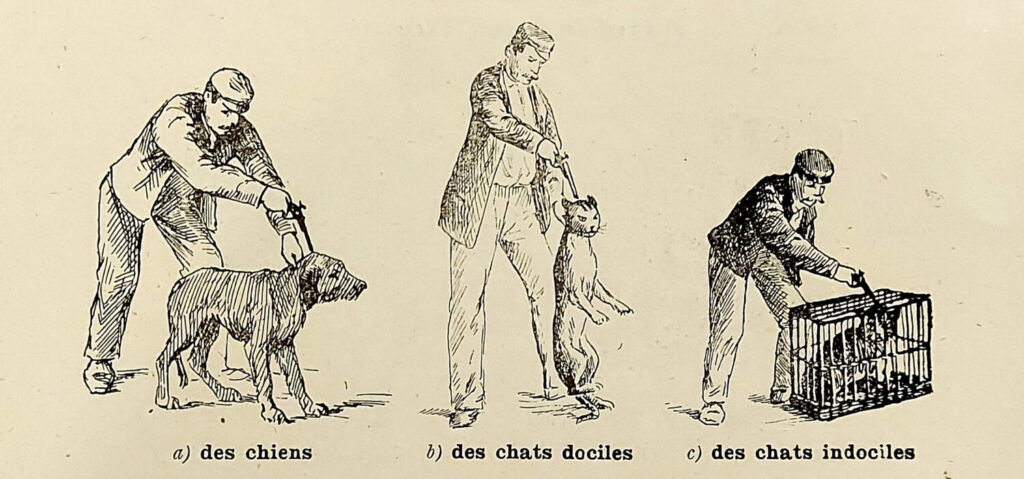
Have a look at the picture above. How do you interpret it? Does it display intolerable cruelty to animals? Is it a harsh reminder that civilization and societal norms form just a thin crust over our selfish, barbaric… animal instincts? That’s a funny reasoning. Then why should we feel bad if we share our ferocity with other animals? But there is an easy way to dodge this tricky question: if man is an animal, then he is also a reasoning one. An “animal rationale”, as Aristotle wrote and he stressed the adjective. On second thoughts, we may consider the images above to be silent witnesses of a brutal past that we have left behind. Are we not more civilized than our great-grandparents, are we not kinder to animals? Still, some readers won’t be convinced. They might argue that the guns in the picture show what our reasoning is capable of. Is there not a cruelty inherent to man, a ‘corruption’ that is actually encouraged by all this talk of so-called progress and civilization?
None of this is new. Each of these three perspectives has been elaborated centuries ago. The pessimistic account was eloquently defended by François de La Rochefoucauld, a seventeenth-century French nobleman who spent a good deal of his life plotting and scheming with or against the powers that were. Not surprisingly, he emphasized the hollowness of public virtues and morality, empty words and forms gravitating around our self-love, the cruelest of passions. That’s one way of putting it. But many a philosopher has argued that morality and civilization do make a real difference, for better or for worse. The optimistic viewpoint is characteristic of Enlightenment thinkers like Voltaire, who defended social progress based on rational thought and science. His antithesis lived just around the corner. Jean-Jacques Rousseau proclaimed that our civilization is not the cure but the disease, a source of moral corruption and inequality pulling us away from the untroubled natural man. Now then, dear reader: choose your winner. Which viewpoint will you defend? Assuming, of course, that these three options are exhaustive.
It is time to reveal the source of the images above. They can be found in a manual published by the “Sociétés contre la cruauté envers les animaux” back in 1902. That’s right: we are dealing with societies against animal cruelty. And the text accompanying the images reads: “Instant destruction without suffering”. According to the manual, shooting abandoned cats and dogs only requires a “skillful and coldblooded man” pulling the trigger, a method much more preferable to clumsy attempts of owners trying to get rid of their four-legged companions by drowning, strangling or burying them. The manual also advised against suffocation with carbonic acid, though the jury was still on out on the use of lighting gas in combination with chloroform.
What to think of all this, more than 120 years after date? Does it correspond to what Nietzsche identified as “refined cruelty”, a morality based upon our thirst for distinction? If so, the history of animal protection is like any other custom: “thoroughly and continuously saturated with blood”, the offspring of a sinister marriage between malice and delight. Without cruelty, no feast. And yet, this would be too hasty a reading because it ignores one of the manual’s main concerns. The former animal protectors did not content themselves with acknowledging the phenomenon of human cruelty to animals. They also wanted to understand its psychological mechanisms. The manual distinguishes a whole spectrum of motifs, ranging from selfish interest to malicious pleasure, prejudice, ignorance and downright carelessness. But in the end, it identified passion as the root cause of all the nasty behavior. Passion, which blinds our reason and clouds our judgment. The manual advises us to calm down and come to our senses. Perhaps like the coldblooded gunner with the steadfast aim who puts cats and dogs out of their misery?
Does the manual still disturb you, dear reader? Surely you can see that it has nothing but good intentions. Or is there something “off” with the wording, phrasing, iconography and methodology? We may recognize what’s at stake, but we don’t exactly reason like this anymore. The uncanny booklet feels simultaneously close and distant. Fortunately, Nietzsche is there to remind us of the fundamental difference between a thing’s origin and its practical application, its “end”. He compares institutes or customs to body organs. In both cases, we cannot simply deduce evolution from its humble beginnings. All “happening” in the organic world consists of “new interpretation and adjustments” over time, making value systems subject to a continuous strain of mutations. The balance of meaning and end slowly shifts over generations. That would explain our feeling of dissociation when confronting animal lovers from 1902. Their manual hasn’t changed the slightest bit, but the eyes of its readers have. It’s a Western lecture, for sure. Our concern for animal well-being is not generally shared on other continents. Estrangement can set in when travelling through space or through time. Let’s stick to the latter dimension, for practical reasons.
The passing of time is a gamechanger. There are many options beyond the three perspectives offered at the outset of this text. We do not need to get boxed in by pessimism, optimism or resentment. There’s plenty of room to maneuver ever since Western civilization reshuffled its cards at the end of the eighteenth century. In a matter of just two or three decades, our mindset took a “historical turn”. By decapitating Louis XVI, French revolutionaries dispensed with the last European monarch representing God. Henceforth, no more regimes backed by unshakable theological doctrine. Across the channel, another revolution: steam and engines propelled man into an industrial era, sweeping the very ground underneath the old society. Meanwhile, Jean-Baptiste de Lamarck conceived the idea of biological evolution. Though he failed to identify its mechanism, the notion of organic change over long periods of time was here to stay. Last but not least, Hegel lifted the anchor of the Platonic realm of Ideas: he introduced dialectics, the process through which human reason and freedom unfold over time. Being was now a matter of becoming. True, it did not make philosophers less ambitious. Hegel and his successors embraced a teleological perspective on development, the strife towards an “ultimate goal” in which their thought and writings would play a pivotal role. Nevertheless, the tide of change had arrived. Motion, mutation, development and transformation were the norm.
It’s a lot to chew, isn’t it? Amazing how thought-provoking a few drawings from 1902 can be. If the old manual against animal cruelty is a fine illustration of the “invisible hand of time”, then its storage place offers an even better example. The subterranean world of archives is itself the outcome of a peculiar evolution. In ancient times, kings and privileged societal actors held their archives close to their chest (or literally in it). The French Revolution changed all of that. Suddenly, archive repositories were erected and in 1794 we get a legal text stating that “all citizens can ask communication of the pieces contained therein”. But if something sounds too good to be true, it probably is. What exactly was supposed to be preserved and communicated? The answer: “Titres domaniaux”, State property titles. The French introduced archival legislation because archives had become a business. The revolutionary government had seized lots of property from the church, the monarchy and emigrants or counter-revolutionaries, leaving it with a vast patrimony… and a considerable source of income. The money acquired by selling these lands was more than welcome to curb budget deficits. And this is where archives kicked in: before you can monetize it, real estate needs to be discovered and registered. The old documents of kings, clergy and nobility were to be squeezed for every penny they had in them. Greed was at the root of the first archive law. Private vices, public benefits: the very definition of what the French called “biens nationaux”. In spite of their unlofty motifs, however, the revolutionaries had understood that the use of archives could radically change over time. The same fate awaited their own rules and regulations. Already by the end of the Napoleonic era, the archive repositories and their staff had undergone a profound mutation. They no longer screened old documents for the State’s financial gain but examined them for their historical value. The repositories became places of memory. Lo and behold, the first half of the nineteenth century gave rise to the archivist as we know him today, an avatar of modern administration who gets to decide on the conservation or destruction of its output. The archivist shearing his flock, or as Carl von Clauswitz might have said: “Archives are too important to be left to administrations”. Unlike his revolutionary predecessors, the archivist now operates within the framework of a democratic society. What a beautiful flower has sprung from a dirty root!
So much for the past and present. What about the future? It’s safe to say that the archivist’s flower will fade. As a matter of fact, the process has already begun. Over the last few decades, Western society has once again undergone profound changes, making the world feel out of joint. Technological breakthroughs have brought us to the shores of cyberspace, an untouchable universe moving with the tide of speed and impulse. This cadence does not support perennity, it makes the archivist look like an old rock standing in a digital flow. Bits and bytes aim to digest. In oblivion they trust. The very notion of the archivist will slowly fade. The word needs to erode, along with its etymology. And no one will notice a vacuum because there will be none: successors are already looming on the horizon. The archivist shall suffer the fate of Kronos, the tyrannical titan from Greek mythology out of whose dissected body the Olympians emerged. What creatures now see the light of day? The ‘records manager’, the ‘data steward’, the ‘information agent’ and the ‘document controller’, amongst others. Not exactly divinities (even though some of them may foster high ambitions), but titles and ranks suited for this day and age, where some yearn for the return of a king in the shape of a CEO. We’ll see how they fare. The question is not whether they can fill in the blanks but whether there will be enough space left afterwards. For that is the challenge of nihilism: fragmentation is one thing, lack of vision is another. A text can only be read if there is enough “empty string” between the words.
Am I the first archivist to proclaim the gradual demise of his profession? Then it must be said: there is much delight in contemplating a sinking sun… from un unsafe space, where pride and contempt copulate.
Nukem 101 – A creature from the underground. One of the worst of a bad lot. Fast, hard to kill and able to either burry or resurrect the dead. A parasite living in the bowels of philosophers, but if they’re strong enough they won’t mind. Enough said.