I used to swim in rivers on hot summer days. The sea was too far away to offer quick relief, so I entered the water that bordered the city instead: The river. I believed proximity meant safety. That being seen was the same as being protected. From their living rooms, people could watch the current carry me away. They might wave. They might remember the emergency number. Or they might decide it was my fault. Who swims outside the river’s engineered boundaries?
Each time I submerged, I imagined an anonymous death — being pulled under, striking my head on a rusted bicycle abandoned on the riverbed, and drowning without witnesses, including myself. A fear I ignored every time.
The river accepts my foot immediately. Brown water and grey clay rise as sediment is disturbed. I search for grip while sludge presses between my toes. Rust-colored silt coils around my calves as I move forward, forcing my body through a substance that resists me. Only once I am deep enough I feel myself being able to swim, keeping my head just above the surface.
Sunlight scatters across the water, showing me a rainbow. Not from rain, but from gasoline oils drifting into my mouth and nose. Pollution reframed as beauty and relief.
Along the quay, small mounds of sand mark where fish have been buried.
Bream, killed by cancer linked to PFOS exposure — a persistent industrial chemical.
Pike, suffocated by dredging and excavation.
Eel, starved after granulate waste and its binding agent, polyacrylamide, were dumped into the river system.
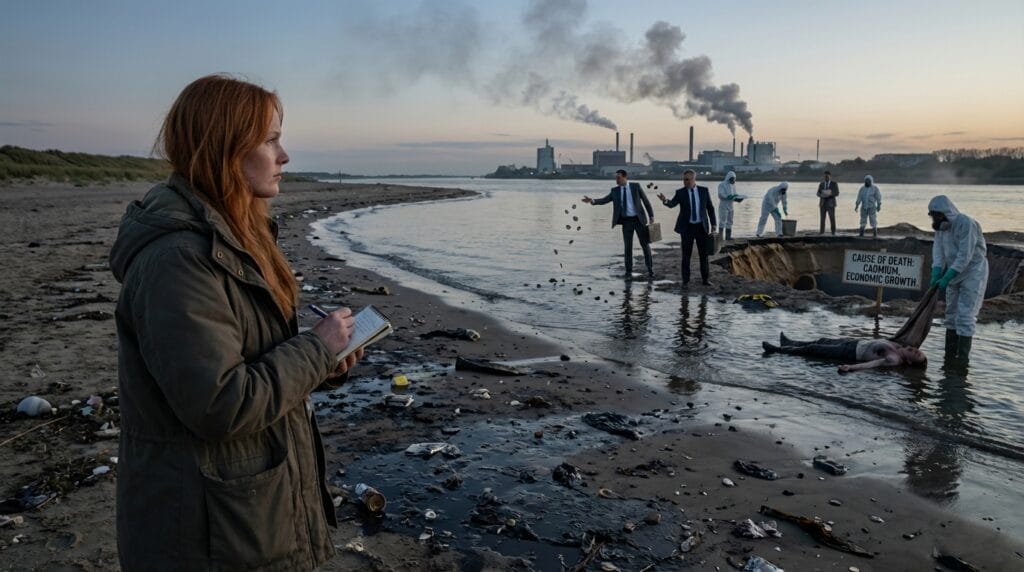
Nearby, a pit remains open. People in hazmat suits are digging in to it a little deeper until men in business suits emerge. Hands are shaken. Papers exchanged. Contracts signed. Then they turn toward the water.
I dive under. The river burns my eyes and airways. When I surface, my name is called. I am told to swim back. Panic erupts on the riverbank. People scream, wave — and are escorted away as they try to lure me back.
Heavy little objects strike my head. They sink immediately. Millions of euro coins spilling into the river. Some of the men watch with pride. Others with concern, afraid it looks as though I might survive this. So they throw more coins at my face. The worth of my silence must be more than millions by now.
A sign is placed beside the pit. It has my name on it.
Cause of death: ignorance, naïveté, integrity — and cadmium.
My body starts to burn and tingle. My lungs filled with acid and asbestos.
Until it stops and my lifeless body gets dragged out of the water, thrown into the pit and gets burried under a pile of polluted clay.
There is no emergency call. No people weaving goodbye.
There is applause for a body donated to pollution and economic growth.