The War Notes 3
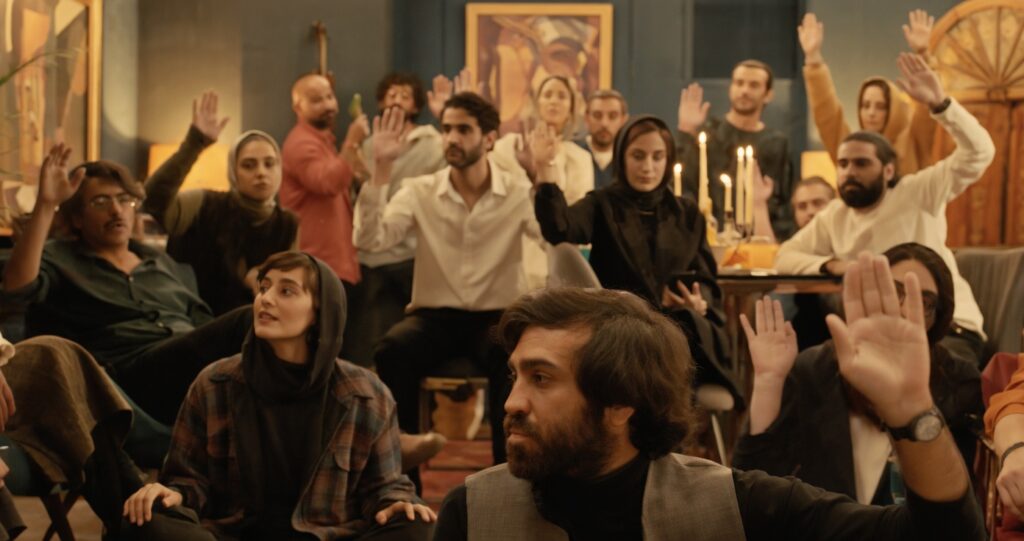
In a scene from an Iranian film called “Six in the Morning”, a girl who is leaving for Europe to continue her studies goes to a farewell party on her last night in Tehran, arranged by her friends. A gathering of young people from Tehran: jokes, laughter, and music. One of the guests asks the girl: “When you finish your studies, will you stay in Europe or return to Iran?” The girl says, “I haven’t thought about it yet.” The guest then asks the whole group the same question: “Guys! If you were students in a Western country, which of you would stay there after finishing your studies?” The entire group raises their hands. Immediately he asks: “Now which of you would return to Iran?” Again, the entire group raises their hands.
Up to that moment, the group had laughed at everything. But none of them laughs at this ironic contradiction that has caught all of them. To them, their answers are neither unreasonable nor a joke. This is the nature of Iranian life, which I understand with all my being.
Think about each of the young people at that party. Leaving a country that from the outside is plagued with sanctions and troubles, and from within is full of restrictions, censorship, and injustice, is certainly the most rational choice. But they would not have had this rational choice, this awareness, and this ability to recognize injustice if they had not grown up in ruined Iran. In which capital of which developed country could they have understood the depth and roots of the world’s contradictions? So in order for their insight and awareness to endure, what choice could be more rational than returning to Iran?
My generation, since adolescence, has lived with paradox, contradiction, conflict, opposition, and inconsistency. For an Iranian, contradiction is not a philosophical decoration of life, nor a theoretical subject of study. Contradiction is life itself.
I will start with concrete and clear examples. Girls who reach the finals of the Asian football championships while having played all their previous matches wearing headscarves, meaning they are deprived of the most basic principles of professional sports physiology. This has been repeated so often that after 50 years they don’t even know that with these scarves, which block the breathing of their skin and body, they start every match already two goals behind their opponent. But what would you say if I told you these same girls have become Asian champions twice so far, without anyone even remembering that they played with hijab?
When I look back and see that my generation, over 50 years, has directly encountered and benefited from the modern world and its tools, yet permission to live in this world had to be issued by a system whose diplomats, governors, ministers, presidents, professors, and policymakers in economy and culture all wear clothing that has no place anywhere in the entire span of history: the cleric’s robe. Our leader was a cleric. Most of our presidents wore the same clothing, and so on. That clothing is a uniform whose content takes the mind to the most remote medieval religious schools, with thick handwritten books, long beards, and stern faces. You can imagine the rest. The clothing of Iran’s leaders over the past 50 years belongs to that time and place.
And what would you say if I told you that whatever the brain inside those black and white turbans is filled with, it is certainly not filled with foreign policy, banking, international relations, global trade, economic development, film festivals, or music. Now you may understand what shame I, as an Iranian citizen, feel every September when I see the president of my country, with that medieval form of clothing and medieval mindset, speaking at the United Nations in New York and inviting the 7 billion people of the world to the paradise of God and the end times of history. It is no coincidence that 80% of the hall empties during Iranian leaders’ speeches, and other world leaders go for coffee breaks. The few who remain are mostly from insignificant countries, and the poor things keep adjusting their translation headsets because the metaphysical speeches of that medieval cleric are not translatable. Headphones capable of translating his words have not yet been invented.
I gave this example to show the outward appearance of contradiction to you, citizens of the developed world, an image you can easily see. But what you have not seen is that since childhood, that robe and that cleric have flowed through every cell of everyday Iranian life. A cleric who rides a Mercedes, eats hamburgers, has an Instagram page posting prayers for the sick, and so on. In a contradiction-free world, a rational world, that cleric should ride a donkey, not a Mercedes. But even if he replaced the Mercedes with a donkey (in an ideal hypothetical situation), he would still have to put his feet on the ground. And the ground in Iran, like in all modern capitals of the world, is asphalt. That cleric has no relationship even with that asphalt and is in contradiction with it.
When I was a child, I saw that religious people in my city firmly believed that the stones on the floor of the shrine of Imam Reza in Mashhad were shiny because of the spiritual light emanating from his tomb. Until one day, around the age of ten, I saw that the stones were being polished by huge machines. And I will never forget when I saw the brand of the machine: Energizer, Made in West Germany. That is contradiction. For 50 years, every day and in 50 different ways, you see the illusion of the heavens ruling over the earth and the necessities of material life. Airplanes were already promised in such-and-such Quranic verse. Quantum mechanics was mentioned by the third grandson of the Prophet in some book. The Terminator movie is actually a cinematic version of some Quranic verse. Islam is complete; it has a version for everything: Islamic banking, Islamic pop music, Islamic human rights, Islamic feminism, Islamic cinema, and so on. If you are Iranian, you no longer even think about the fact that the phrase “Islamic banking” itself is an ocean of contradiction.
Understanding contradiction is neither good nor bad. Understanding conflicts makes you mature earlier than your peers in Australia or California. You learn that it is what it is. And you let go and laugh. Yes. For a young Iranian, maturity is not about tasting the bitter and sweet of life. Here, maturity means surrender, giving in to a life full of contradictions. Iranian maturity comes around the age of twenty-five, when you begin to believe that the world holds no reward for you; when you realize that your only certainty is this: that Iranians are not players in the game of world and history; the certainty that the wind of oblivion had blown long before you arrived.
Now let’s return to those young people at the party. They do not have inner contradictions that leave them torn between staying and returning. They themselves are the meaning of contradiction.
These days, out of worry, I avoid checking my phone, so I won’t receive bad news from Iran and my friends and family during the war. Today I managed, with difficulty and slow internet there, to talk a little with my friend Mehrdad, who is a musician. I told him about my worries. He laughed and said: “Mohsen! My only sadness these days is that if this war ends, where will we get adrenaline from? Where will we get excitement after it ends?” And he laughed loudly. I laughed too and said to myself: You truly are Iranian.
As a line from a Persian pop song says: “Iranians always endure; no one is like an Iranian.”
Mohsen Namjoo is widely regarded as the most influential Iranian musician of his generation, an artist who has significantly expanded the possibilities of Persian music in the 21st century. Born in 1976 in Torbat-e Jam, he trained rigorously in the canon of Persian classical music before integrating it with blues, rock, jazz, and experimental vocal techniques. No other Iranian artist has so extensively broadened the emotional and sonic vocabulary of the tradition while remaining rooted in it.
Namjoo has become a prominent voice of artistic engagement for millions. His early underground recordings in Iran circulated hand to hand, building a devoted following long before exile carried him onto international stages. From Europe to North America, his concerts are acts of collective reckoning, where satire, lament, mysticism, and social commentary collide.
We at The Unsafe House had the honor to interview Mohsen Namjoo on The Unsafe Podcast, and specifically discussed his project Minooor, exploring its experimental approach and the depths of sonic exploration.
This is the third installment of Mohsen Namjoo’s column The War Notes, written exclusively for The Unsafe Journal.