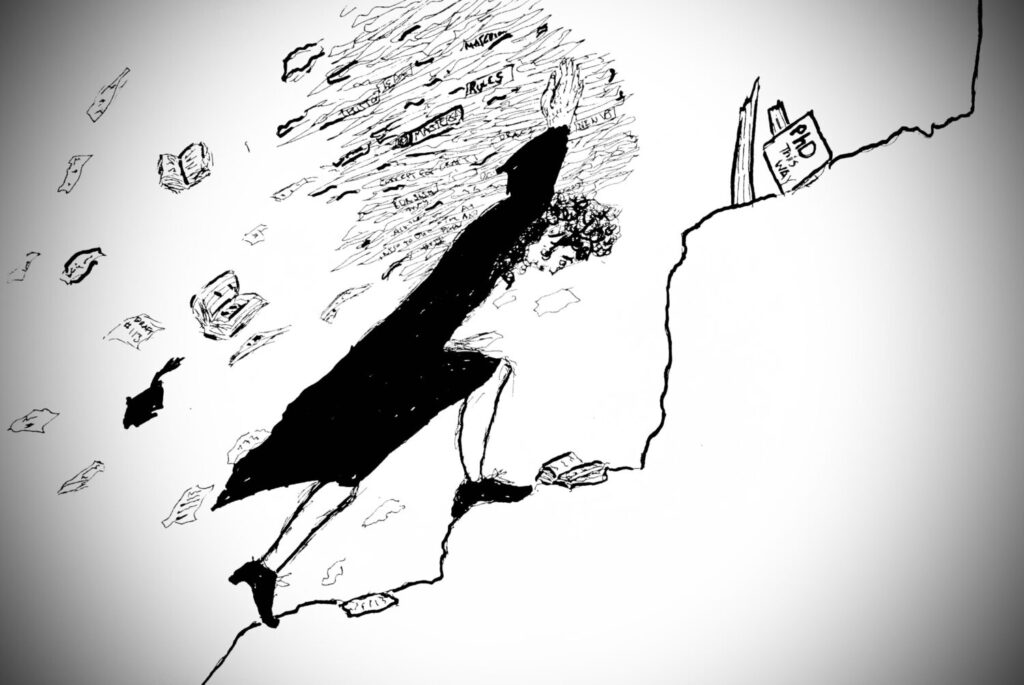
Dear Editors at The Unsafe Journal:
Thank you for considering my article for publication. Confidentially, there is some urgency to my submission, as my visa is due to expire and Maasdam University is refusing to extend it. Their argument is that I have not published enough articles in academic journals to justify continuing my doctoral research. And since I am required to publish ten articles which I can ultimately bring to defense, the fact that I only have three after countless years of toiling has become quite the obstacle. In short: they are threatening to deport me. My parents, meanwhile, are threatening to send me to an Upper-East-Side shrink if I get deported back to Manhattan. So I really do need to hear from you as soon as possible.
At my last meeting with my supervisors, I tried to explain, in the simplest terms possible, that there was an international conspiracy at play against the publication of my work – to little effect. But how else does one justify the rejection of my research by no less than 68 journals across Western Europe and the United States? Either all journals have reached a consensus on what they do and do not publish, or there is a file on me making the rounds. Either way, I need to show Maasdam University seven peer-reviewed journal publications before my visa runs out. I was told by a friend that you might be ‘accommodating’, whatever that means. I hope you can help me. I trust you are peer-reviewed?
My research should be of interest to you. It concerns a painter, Halibut Schmidt. Halibut can be spelled variously: sometimes it is spelled Heilbot, sometimes Halibutt (with two t’s, as in the shortened form for buttocks), and very occasionally as Heil-Butt. He was born in 1886, in Soerabaja, and died in 1972, in Lech-am-Arlberg, Austria. I am nearly certain you have never heard of him.
If you’re wondering how there could possibly be an international conspiracy revolving around a painter nobody’s ever heard of, you’ve hit the nail on the head. That is the conspiracy! They don’t want you to have heard of him. They don’t want you to know his name or ever even think about him. And yet his works hang in no shortage of esteemed halls and offices (and, might I add, a few raunchy bathrooms) across these flat, flat lands: several prime ministers have chosen his works from the State Depots to adorn their office walls in het torentje. Museum directors keep him in storage but most privately acknowledge him as their favorite, and the best. Professors and snobs alike agree: Halibut Schmidt is excellent. Now you know.
But why is he excellent? Let us examine the scholarship to see what answers they provide. Schmidt boasts a large oeuvre comprising mostly flat landscapes. However, in between bouts of landscape painting Schmidt would periodically embark on more ambitious projects, and it is these works which fetch the most money at auction. These include, but are not limited to, Sieg Heil (1933), Herrenvolk (1935), Blut und Ehre (1938), Arbeit Macht Frei (1947) and Der Verlorene Himmel (1972). All of the above hang in public collections.
Schmidt boasts three catalogue raisonnés, written by two art historians. A small circle of recognized specialists has emerged around his work. The consensus among these art historians is that Schmidt’s forte was landscape painting, and he brought that self-same frame of mind to the aforementioned works, Sieg Heil et al. To quote art historian Ernst Baksteen, ‘Sieg Heil, a self-portrait of the artist with his arm striking upward across the canvas at a diagonal, plays with the same question of lines and horizons as his landscape Sunset over Oss. The painting is not so much about the painter as it is about the question of angles, and the important role they play within a composition.’[1] On the title itself cultural analyst Saskia Ridder-de Witt has suggested it is ‘an onomatopoeia, expressing the sound of the diagonal line as it slices through the genre of traditional portraiture and heightens it to new, discursive planes.’[2] Most recently the background of the painting, made up of bright red flags with black swastikas in white circles, has been articulated as a ‘further elaboration of the artist’s exploration of sound, color, and angles’ by art historian Karin Schoonmaakster.[3]
The most recent exhibition of Schmidt’s work was staged in Spring 2016 at the New Museum in Maasdam. Halibut Schmidt. The Quiet Feminist presented a retrospective of Schmidt’s work alongside paintings by prominent female contemporaries, drawing parallels between the artists’ personal struggles and aspirations, as well as between the forms on their canvases. One contributor to the catalogue, Betty van der Tieten, wrote about what she called Schmidt’s ‘mammographical geography’, comparing his depictions of bombed-out hills around Nijmegen to the small or misshapen breasts frequently depicted by the queer and self-proclaimed ‘stateless’ painter Heidi Groß (b. 1974).[4] The catalogue positioned this article as a debate with Frits van der Laffe, whose own contribution countered that the swastika-theme employed in Sieg Heil, Der Fahne Hoch and Der Verlorene Himmel could be more appropriately described as ‘pertaining to a minimalist, rectal-aesthetic.’[5]
The Quiet Feminist elevated Schmidt within contemporary scholarly discourse by framing him as conceptually relevant. Recently, he has attracted the attention of the internationally renowned trans theorist and intersectional activist Alex Pik, who included Schmidt in their groundbreaking study, Painting for Palestine (2018). According to Pik, Schmidt’s work ‘exists at the intersection of trans and diasporic identity, shaping them through bold colors and forceful physical motion, as if leading the charge against the oppressor of freedom.’[6]
In 2018 I published my first article on Schmidt, suggesting, on the basis of the abundance of swastikas and Hitler salutes, as well as on his fifteen-year membership in the Nazi party, that he might have been a Nazi.[7] Honestly, I thought nothing of publishing this article. Other scholars had taken egregious liberties with his oeuvre; why should my interpretation, based purely on what I saw, provoke an uproar?
In a sense, I was right: the article was greeted with radio silence. But I received criticism in another form, namely an unscientific form, which the constraints of academic writing forbid me from including as legitimate argumentation. I will confide to you what happened in this introductory letter, in the hope that your journal, my last hope, might have sympathy for me, and decide to take my work seriously.
About ten days after I published that first article, I noticed a man sitting outside a local café on the corner from my office at the university. I noticed him because he had been sitting at the same table the day before, and the day before that, at exactly the hour I left the office. I didn’t think much of it; either the café had become a part of this man’s newfound routine, or I had simply failed to notice him before. A work week went by during which I passed this man every day on my way home. His face was always partially covered. Sometimes he wore a hat, other times a hooded sweatshirt, and occasionally sunglasses. I could feel his eyes on my back as I walked past. I couldn’t tell you what he looked like now. It sounds strange but it’s true. It’s as if he calculated his disguise to be as inconspicuously effective as possible: I never saw enough of his face in order to create a full picture.
The next week he was gone. And then, the following Monday, just as I had started to forget about him, there he was again. This time, however, he had a white and black-spotted cat on his lap and was stroking its back. I assumed the cat belonged to the café.
That afternoon, as I passed him, he rose from his seat and followed me, carrying the cat with him. I could hear his footsteps behind me: slow and steady, punctuated by meows. When I stopped at the intersection, he stopped alongside of me. I turned to look at the cat. The man grinned – a wide, toothy grin framed by dark stubble. The pedestrian light was red; a bus was approaching at full speed. Just as it was about to blaze across the zebra crossing, the man threw the cat into the road.
I screamed. When I turned back, the man was gone.
There was no blood on the road, nor did I catch sight of the cat. You might think I’m making this up, but I promise I’m not (if I were, wouldn’t I leave these last details out?). Cats are agile, so my only explanation is that it maneuvered itself to safety. But you understand what I mean to convey with this story, don’t you? It was a warning. Who sent it, I don’t know, but I didn’t ask that question then. I was young and thought: I must be crazy. Nobody cares enough about Halibut Schmidt, about art history, to terrorize a PhD student.
Please let me know if you are interested in publishing my research. As soon as I hear from you I will send you my article for consideration.
Respectfully,
Sisyphus.
P.S. If you do write back to me, please do it electronically only. Do not send me any physical mail – including your journal. At the moment I do not have a physical address.
References
- Baksteen, Halibut Schmidt (1886-1972). Painter of Peaceful Horizons, Spoorloos Uitgeverij 1975, 46.
- Ridder-de Witt, ‘Rethinking representation. Four case studies of perceiving sound in 20th century portraiture’, in Charlotte Farsifal (ed). Revolutionary Discourse: Ten Studies that have changed the world. Hax University Press 2010, 132.
- Schoonmaakster. ‘Sieg Heil by Halibut Schmidt. Recent research developments.’ NCA Bulletin 178(2012), no. 3, 27.
- Van der Tieten, Mammographical Imaginaries, B.L. Ocks Publishing House 2014, 192 and Van der Tieten, ‘Schmidt/Groß: an unlikely alliance?’ in Baksteen, Schoonmaakster et al. exh. cat. Halibut Schmidt. The Quiet Feminist, Maasdam (New Museum) 2016, 84.
- Van der Laffe, ‘The Rectal Aesthetic of Halibut Schmidt’ in Baksteen, Schoonmaakster et al. exh. cat. Halibut Schmidt. The Quiet Feminist, Maasdam (New Museum) 2016, 104 – 114.
- Pik, Painting for Palestine. Diachronic allies of the Global South, Gil Brish Publishing 2018, 76-91.
- Sisyphus, ‘Sieg Heil by Halibut Schmidt: A National Socialist painting?’, NCA Bulletin 224 (2018), no. 2, 18-19.
Susana Puente (b. 1992, New York) is a writer and an art historian based in Amsterdam, The Netherlands. She is the author of De God van Nederland. Leven en werk van Pyke Koch (Prometheus 2026).