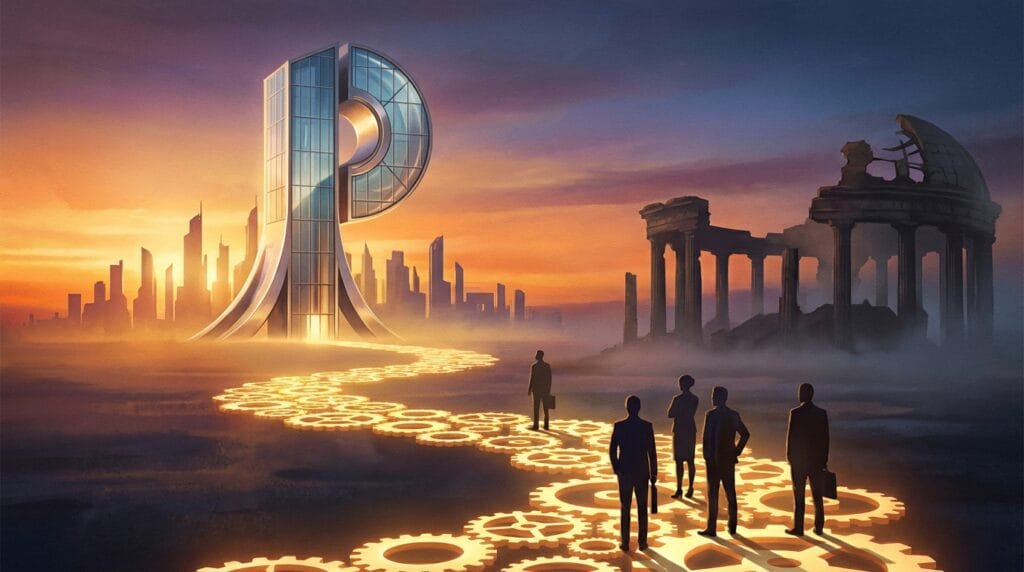
The institutions of the free world are driving it towards disaster.
To the observant, it’s all too clear. Slowly but surely, the free world is heading towards disaster. We’re faced with great problems that are growing rapidly. Institutions are becoming increasingly inefficient and corrupt, while our national debts keep rising to the point of state bankruptcy. While our populations are aging, large numbers of unskilled migrants are settling in our countries, contributing to higher levels of crime and receiving more from our welfare states than they contribute. Racial and religious strife are increasing, with ethnic minorities increasingly convinced of their victimhood and majorities increasingly convinced of the minorities’ hostility. Religious extremism is on the rise, and terror attacks that were once rare, shocking events have now become a regular occurrence.
Inevitably, these developments will reach a boiling point. Our governments will go bankrupt and hyperinflation will follow. Material prosperity will decline. Our streets will no longer be safe as gangs will roam around looking for victims. A lack of safety will reduce trust, driving communities apart. Ethnic tensions will escalate into armed confrontations. What are now rich and safe countries will end up like Argentina, South Africa and Lebanon.
Not so long ago, Argentina was one of the world’s richest countries. Millions of Europeans moved there to build a better life and its then beautiful capital was known as ‘the Paris of Latin America’. But things changed when the system descended into corruption and socialism. One regulation after the other was passed to protect cronies from competition. Its economy started stagnating and the country went into decline. By now, Argentina is a poor country by modern standards. What was once a country richer than most western nations is now a ‘developing country’.
South Africa, despite its apartheid, was once a rich, safe country. Now, the country faces blackouts and rampant crime while its infrastructure is crumbling. People have to take extreme measures to protect themselves and their families. A radical communist party chanting genocidal slogans has become one of its largest political movements. Its problems are reaching a boiling point, it has descended into third world poverty, and those who can afford to have retreated into protected private communities.[1]
Lebanon was once peaceful, rich and beautiful. Its capital, Beirut, was called the Paris of the Middle East. After suffering a brutal civil war, it became a failed state. Millions of people have left the country. It’s now one of the poorest countries in the world. Its people have ended up divided into isolated religious groups resorting to militias for protection. The country’s government is corrupt and dysfunctional. We could barely even call it a country anymore.
That’s what we’re heading towards. If our political dysfunction isn’t solved soon, it won’t be long before our civilisation will belong to history like those that have come before. But even if these problems had not existed, there’s a whole civilisation that never emerged because of the same system that now drives ours into the ground.
What’s Already Dead, and What Was Never Born
Many democratic countries never got the chance to flourish. Waste, corruption, bureaucracy, overregulation, overtaxation and a lack of rule of law have kept millions in liberal, democratic nations in poverty. Their governments are so corrupt and dysfunctional that few people dare to invest. Entrepreneurs would have to compete against oligarchs, overcome huge costs and hindrances in starting their businesses and risk that their rights aren’t respected. Police, prosecutors and judges are slow and ineffective, and don’t dare to challenge the power of the cartels, mafia and gangs. Criminal organisations are a big threat to business. Millions of hard-working entrepreneurs face regular extortion. The runaway corruption, overregulation and bureaucracy, as well as the lack of rule of law and the constant threat of powerful criminal organisations make investing in these places a bad idea. In the many dysfunctional democracies, the resulting lack of good jobs keeps millions of people in abject poverty. They have no chance to reach their potential and to give their families a good life. Democratic governments have failed miserably in many ways and many places.
The resulting extreme and widespread poverty has made millions of people risk their lives migrating to better shores. Tens of millions of people have left Latin America for the United States, and millions of Africans have risked their lives on rubber dinghies to reach the shores of Europe.
Even in Europe, regions once rich and significant, like Sicily, are now poor and dysfunctional. The young are leaving in droves, in search of better opportunities. Palermo was once a city as important as Paris, and Sicily’s former wealth can be seen in the beauty of its cathedrals and palaces. For a long time, its vestiges of former prosperity have been deteriorating.
One can only imagine how these societies would look if their governments had been better. Africans could have built better lives while staying near their families instead of risking their lives crossing the Mediterranean. Latin America would be a vast, rich region. Prostitution and crime would not be nearly as common there as it is now. Modern, rich civilisations would have had a chance to be born. Sicily, Greece, Turkey and so many other places would have kept their magnificence. But alas, this never happened.
Our Politics and Organisations, and Their Impact on Society
Our culture is in decay and our society is coming apart. As opposed to places like Dubai and Singapore, many places in our countries are dangerous because of bad policing. This has caused a great decline in trust. Children aren’t allowed to play outside anymore and are told not to talk to strangers. Theft and stabbings have become common in cities like London and Paris as well as American urban centres. This stands in stark contrast with places like Dubai, Saudi Arabia and Singapore, where crime is rare and strangers can be trusted.
The quality of public discourse has reached a low point. Many mass media companies deliberately spread lies and obfuscate important truths. Government subsidies have made them into political partisans. The universities are controlled by leftist ideologues. The ‘NGO-industrial complex’, a well-funded industry of nongovernmental organisations, produces partisan political propaganda against their ideological opponents and the political opponents of their patrons. Of course, considering the subsidies they get, they’re not nongovernmental at all.
Ethnic tensions are rising. While multicultural societies can thrive perfectly, our political system undermines this. Electoral politics is to appeal to the whims, fancies, superstitions and fears of the masses. It sows racial and religious antagonism. The democratic system and the nature of the electorate favour politicians who portray certain groups as a threat. Some politicians portray migrants as a threat to jobs and a drain on the welfare state while others portray native populations as oppressors who discriminate against newcomers. Left-wing politicians have decided to take in millions of immigrants as their new, loyal voters. It’s not entrepreneurs, engineers and doctors they let in, but low income groups who vote for their parties. Furthermore, they increasingly collaborate with extremist religious organisations to garner votes. In return for subsidies and turning a blind eye to religious extremism, these organisations have become firm bastions of support for the left. In the worst cases, such as the United Kingdom, this has made local police allow the rape of thousands of English girls by Pakistani and other Muslim rape gangs. To keep their electoral bases, local parties have turned a blind eye to vast human rights abuses and the deliberate spread of hate. Pursuing political self-interest, left-wing politicians facilitate the Muslim brotherhood, resulting in extremism, ethnic tensions, hate crimes and terror attacks. While they initially encouraged and facilitated mass immigration to get new low income voters, their model has now shifted to what’s in fact collaboration with extremist religious institutions.
This didn’t have to happen. Thriving multicultural societies exist, some of which include large Muslim populations. This includes Dubai, Israel and Singapore.[2] Through effective policies, they have sown harmony among their multicultural populations. Western nations, on the other hand, with their ethnic particularist politics, are splitting apart.
Discrimination against ethnic minorities is on the rise, in particular against Jews. In the west, synagogues and Jewish schools now need to take extreme security measures. Governments make little effort against antisemitism, and the plight of our Jewish friends is mostly ignored. In Western and Southern Europe, it’s no longer safe to be Jewish in public. Jews hide their identities out of reasonable fears of antisemitism. It’s an absolute disgrace that this is the situation in Europe only 80 years after the shoah.
Under the acronym ‘diversity, equity and inclusion’, discrimination against ethnic groups is now practised by many corporations, government institutions and even militaries. Asians, Jews and white people are discriminated against in favour of groups who, on average, perform worse.
Meanwhile, millions of people are oppressed or stuck in warzones with nowhere to go. They deserve a government that protects them and treats them better. Many countries don’t take in refugees, and the journey to the west is expensive and dangerous. Most people who deserve refuge can’t get it and not a single government actively tries to attract them. Social welfare dependents are welcomed and illegal criminals aren’t deported, but millions of decent people are left in danger and misery.
A Common Culprit and a Common Solution
The greatest problems our societies face today, including the ones mentioned, have one common cause: noncapitalist institutions, in particular our governments. To solve the problems that could spell the collapse of our civilisation, we need a capitalist revolution in our political and nonpolitical institutions. Many people will reject this, because they’ve been educated to believe in a certain deity. But this deity isn’t holy at all. People falsely believe that is has liberated us from oppression, feeds the hungry and clothes the poor, and that we’d suffer without it. It’s the deity of democracy. Like an addict stuck to his drug, we hold on to this modern deity for dear life and to our doom. Besides causing the problems that are slowly becoming disastrous, this system keeps many people from reaching their potential, involves widespread corruption and waste, and allows radicals to affect the governance of our society. Incompetence, a lack of rule of law, waste, corruption, bureaucratic bloat and overregulation, overtaxation and ideological policy making—entire countries suffer under the failure of democracy. Mass democracy is the biggest mistake in modern history.
Democracy isn’t all bad. It has its unique benefits and we shouldn’t do away with it completely. In most respects, however, democracy is a false god. It’s the cause behind the greatest problems many countries face and definitely isn’t the best system of government.
There’s a better alternative: the democracy of the free market. For-profit governments, with shareholders instead of voters, that compete for taxpayers and treat them as customers. If these new “proprietary states” are instituted properly, we’ll be ruled in our own interests by those who are best at it. Proprietary governments will then aim to give us the governance we prefer, fearing that we will otherwise leave to other jurisdictions. It’s a form of democracy where people vote with their feet. This will result in a civilisation governed by entrepreneurs who, in their pursuit of profit, will create the conditions people prefer. They can pick up the crown that has been left in the gutter, revive our civilisation and set it back on the course for co-existence and prosperity.
The dysfunction of democracy is part of the wider problem of dysfunctional noncapitalist institutions. From governments to nonprofits, noncapitalist institutions have become increasingly detrimental to society. To solve this problem, we need revolutionary capitalism—An entrepreneurial effort to privatise our systems. We must privatise governance, weaken states in favour of the private sector and dismantle problematic noncapitalist institutions.
While the problems we face today are great, this manifesto carries a hopeful message. If we can advance capitalism and the proprietary state becomes the dominant form of government, the world will reach a level of prosperity and harmony it has never seen before. The age of nation states, failed states and ethnic strife will belong to history, and people will wonder how we could ever have believed so religiously in democracy. This little dark age will make way for a new renaissance, a lasting belle époque.
References
- A great article on the decline of South Africa, explaining its dysfunctional politics: https://www.palladiummag.com/2025/03/14/south-africas-racketeer-party-state/
- Proprietary governance will, in practice, look very much like what Singapore and Dubai have. As Isaac R. Ohrenstein, explains:“Singapore and Dubai have built exceptional infrastructure without compromising on multiculturalism. Their governments developed glistening skylines full of luxury hotels, high-end restaurants, and world-class museums. Both countries have constructed major seaports and airports to transport astounding numbers of passengers, with Dubai International Airport serving a staggering 97.3 million people in 2019 and Singapore Changi Airport handeling 68.3 million passengers during the same period. At the same time, Singapore balances the religious and cultural interests of ethnic Chinese, Malays, and Indians with minimal discrimination. In Dubai, located in a part of the world notorious for religious intolerance, Christians and Jews are allowed to practice their religion freely. In both places, people of all faiths walk safely in the street, and there are diverse places of worship including churches and synagogues.” The Rise of the Singapore-Dubai Model: Opportunities for Expansion in Africa, Latin America, and Beyond. Isaac R. Ohrenstein, 20 February 2023, Harvard International Review.