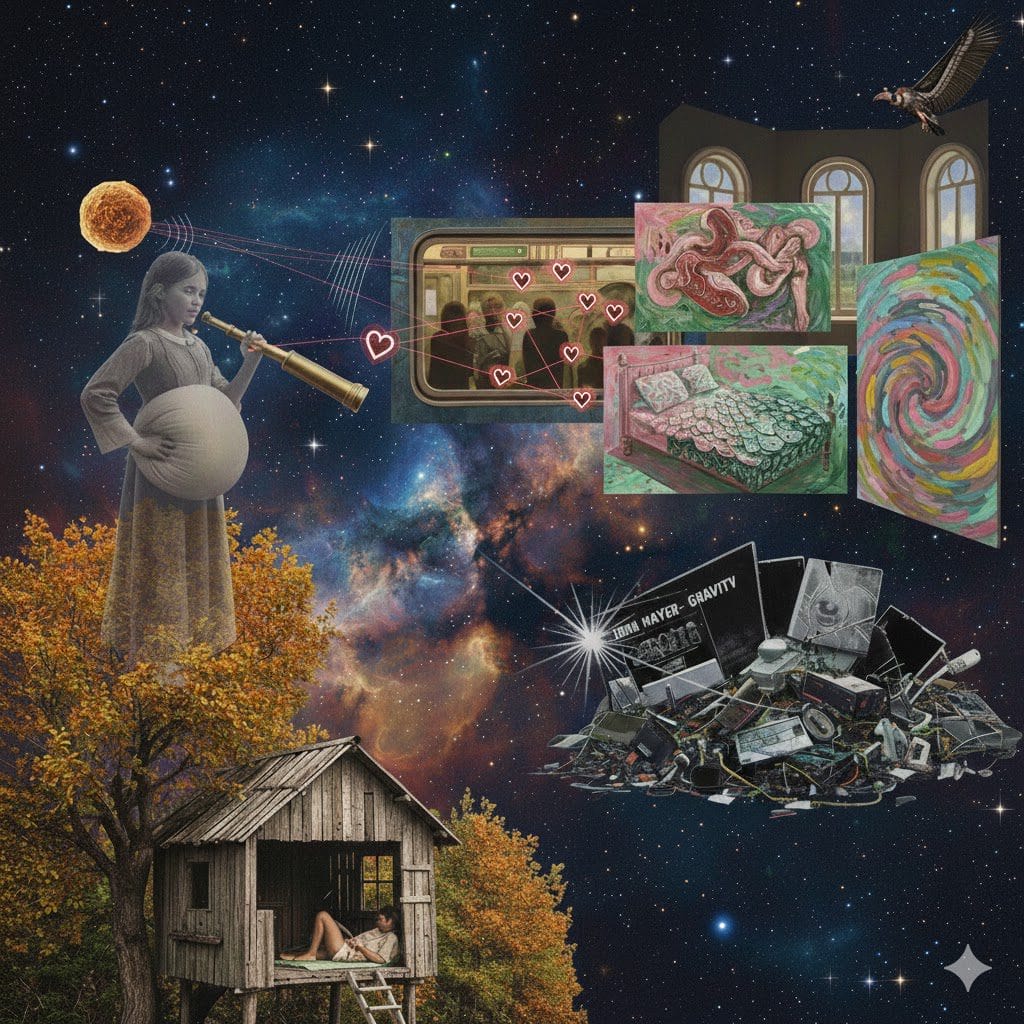
I was cast as Galileo Galilei at age 12. I wanted to be feminine, not an old man with a pillow strapped around me for a belly. But if this was my time to shine, I would shine well. With a hunched back and crooked growl, I enunciated my lines. I wasn’t going to be the lead next year, so I had to make it count.
Uranium is the heaviest naturally occurring element. Its nucleus is unstable, meaning the element is in a constant state of decay, seeking a more stable arrangement. I sometimes imagine a small globule of this material being laid next to me — its weight tearing through our mutually supporting surface. So much weight in so little circumference. We would fall at the same speed, through the roof, or the treehouse, or the aircraft. As the clouds became our new medium, I would reach out as if to hold its hand. How can an object have so much impact?
On the subway you can notice lattices of attraction. I do it like this: I let my attention move lazily around the car and approach the person I’m naturally drawn to. There is no need to make any decisions. Sometimes this soft awareness is not necessary because it’s obvious where my attention has landed. I feel a pull on the edges of my skin. My eyes meet another pair of eyes and hearts move.
I walk up the stairs to an exhibition in Berlin. The gallery opens to a hexagonal room. Tall windows illuminate large oil works by Jill Mulleady. The paint is luminescent. Like fish scales, the pinks, greens and blues shimmer from the well crafted linens on an unmade bed. In another painting, two figures intertwine. They look like slices of meat trapped in a window, or some kind of animal caught in a lab. Maybe there’s no good way to describe how much you can love a painting, or how it empties your head. I want to move towards the colors and melt into the shapes. Silence can help. But sometimes — if music is playing — I can’t imagine the experience without that particular music. Or if it’s busy, it would have always been ideal to view the painting in a crowd. Sometimes, the way it appears in that first moment is the best possible expression of itself. Other times my attraction is refracted and frustrated by annoying circumstances and people. It becomes hard to feel the weight of the thing in front of me. I spend my time wishing everything was a little different than it is. How does the world reach me?
Someone once told me about the “happiness gap” between them and a friend. They didn’t feel like it was possible to be close with this old friend, because the friend was too happy. Their feelings couldn’t reach each other — they found no tender ground. In a radio show about break-ups a woman decides to write her own break-up song. She emails Phil Collins as the king of dramatized emotions, and surprisingly, he writes back with his phone number. He gives her advice on how to write the most pathetic break-up song. How to make herself into a pleading baby with no standards save getting her boyfriend back. At the end of their call she asks him, do you think I’ll ever be happy again? Will I let go?
In space there are giant balls of trash and debris and human paraphernalia caught in orbit. Waste with the most beautiful view. Waste that we cannot let go of. This waste is referenced in poems and songs and paintings and movies. It is discussed on ecological podcasts or in lectures or on the news. It’s a fascinating problem, maybe because it’s so spectacular that trash is having this profound experience. On the other hand, trash is polluting this profound space. On the other hand, this has nothing to do with trash and everything to do with where our attention drifts.
The first CD I owned was S CLUB 7. That was when I shared a room with my older sister and she made me slip dollars beneath the door as an entrance fee. One could say she heightened the stakes of my musical anticipation. My second CD was Gravity by John Mayor. Given to me by the same sister as a way to — in her words — bridge the gap of my trash music taste to something not yet good, but better. She liked old music and believed it was of a higher quality than the embarrassing effusions of our generation. I liked pop music played on KISS FM. In order to feel closer to my sister, I spent hours listening to Gravity. I memorized the lyrics and developed a soft affection for the sounds. There was a song on the CD called Vultures that I listened to on repeat. I admired the brutal yet elegant nature of this bird. By now, I lived in the room next to my sister, our brother having moved to the basement. I was able to move up in the stratosphere.
This morning I walked through the garden of my friend’s home. There is a treehouse someone built in the woods years ago. It’s on the edge of where the lived-in-outdoors becomes the forest. I climbed up and curled myself onto a mat left on the structure’s floor. I imagined myself from above, collapsed like a weak, exhausted animal. I had been crying and wanted to cry again. The leaves of a neighboring tree mingled with the leaves of my tree-house tree. They rustled in waves as the wind swept through the valley. I repeated to myself in low tones, the world moves the world.
The following text was prompted by an AI to write a bio for the author in the comedic style of Sina Khani:
“Siena Powers? Yeah, she’s the Art Editor at Sand Magazine, that Berlin-based literary and arts rag that gets its rocks off on bold, no-bullshit expression—the kind that stares you down and dares you to blink first. Straight out of New England’s creepy, fog-shrouded underbelly, where even the trees look like they’re hiding bodies, Siena dumps her antsy, scattershot curiosity into all sorts of twisted shit: from the gut-punch rawness of visual art and those spine-tingling audio dives that echo like ghosts in your ear, to the fake-as-fuck drama of theater and the mind-fuck mazes of literature that’ll leave you questioning your own sanity.”