The War Notes 1
1
Let me begin with two familiar texts.
The first is a Persian proverb: nothing is darker than black.
For years Iranians have lived the emptiness and camp of that sentence with every cell of their bodies. This disgraced, natural born killing government has shown us again and again that there is a color darker than black: the darker killings of the next year.
When you live in one of the richest lands in the world and still cannot feed your family, life is black. You go to the street to protest, unarmed, not even throwing stones, and they kill you. You and the people of your town. Then the darkness of your absence becomes darker than the darkness of feeding your children hunger. Three hundred dead is darker than seventy. Fifteen hundred darker than three hundred. Tens of thousands darker still.
As Paul Celan wrote, the black milk of morning is drunk at noon and night as well. In Iran milk is not white. It is black. Snow is black. Black. Absolute black.
Where is the physicist of light? Where is the scholar of color to see that there is a land in the Middle East where every year unveils a blacker black? Grief dresses you in black, but when you do not know who killed your little daughter, what color is left to wear?
A friend once told me: the market for black shirts thrives in this wasteland.
The second text is a line from a song by Siavash Ghomayshi, written by my dear friend Yaghma Golrouee: I grew tired. I sang so many songs and the season never turned back.
After every massacre I promise myself I will not make music anymore. I try to stop this automatic reaction, not to answer suffering with melody. Why? Because I am deeply tired of the uselessness of my existence in front of so many young lives turned into death. I am ashamed of my inaction, our helplessness, our lack of justice. So many have died that I am tired even of being ashamed. Tired of living, of composing.
Let the melody come or not come. I do not care. But every time a darker darkness arrives, my soul catches fire and I have no choice. I have to shout.
How many, you shameless one? Hey you Supreme one. How many thousands?
What fever inside you turns a whole country into the neighborhood’s stubborn child, feared, avoided, humiliated? Do not kill. Do not. You may stand above us, but you are not above history. I wish at least you were not cowardly. Hell of hell.
2
Years ago I said we Iranians were not the most miserable people on earth. I was wrong. We are the most tragic, the most oppressed, the most grieving people.
Now, in the winter of 1404, after what has been done to my people, I want to shout: we broke the record. By every measure ninety million stand at the front of the line of sorrow. Show me one government that kills its own people like this in two or three days.
People of the world, listen. Our leaders kill us in the streets. And the wounded taken to hospital are killed there too. They know neither trade nor diplomacy nor progress nor the simplest meaning of leadership. They specialize only in killing, in empty sermons, in promises of heaven.
You protest and they beat you until you die. And what death? A wasted one. Not even heaven will take it. For fifty years we have acted inside the screenplay of violent, sick minds in black turbans.
God, bring my death soon. I am tired of music, beauty, singing, recording. Everything.
3
The piece Name was made with artificial intelligence. I say this because I cannot reveal the names of the kind artist friends who helped me create it and its video. Everything you hear except my voice is AI.
I say this to the killers: by killing sprouts you only risk their growing back more of them. The piece sounds through AI as a symbol of the future, a future you cannot understand. Your turbans have filtered your minds so long that only the past passes through: your myths, your old stories. You smell of the past.
Those young people, like this bitter music, like artists’ imaginations, like the dreams you shot on asphalt, belong to the future. We are the future. You are the barrier. Every muscle of my throat hates you.
4
When I burned from the news of your crimes, I wanted to scream but had no words. There was melody but no text. Rhythm but no language.
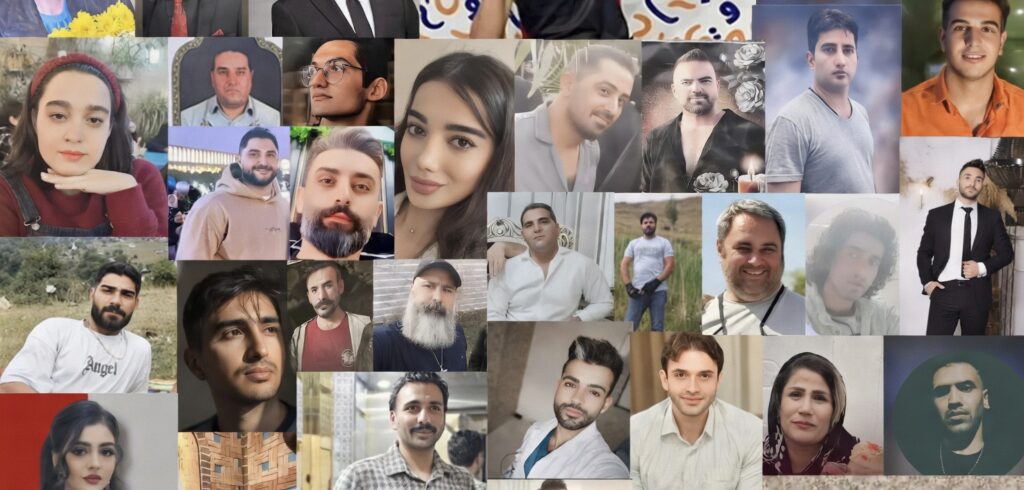
Then days ago I saw a list of names, red tulips, each with father’s name and national ID. Hitler. Pol Pot. Genghis. Even they did not have your audacity. They killed in darkness or war. They did not publish the citizen number of a murdered child.
With the beat in my head I spoke the first name, then the second, the third, the next. Eight names across four bars. Eight more across the next chord. Slowly the names themselves became poetry. Sixteen names per line. Thirty two per couplet. Twenty five couplets. Eight hundred names.
The piece ended, and I had not read even three percent of the list. How many did you kill? How many dreams? How many futures? How many families? How many final bullets? How many leaves fallen from the tree of life?
Why does this cursed autumn never end? Why does this death fugue never stop?
When the sun sets in Iran,
your golden hair, Fatemeh.
Your greying hair, Masoud.
We drink the black milk of dawn at dusk, morning, noon, and night.
We drink and drink it, and we dig a grave in the air.
Your golden hair, Fatemeh.
Your greying hair, Masoud.
(Inspired by the poem “Death Fugue” by Paul Celan)
Mohsen Namjoo is widely regarded as the most influential Iranian musician of his generation, an artist who has significantly expanded the possibilities of Persian music in the 21st century.
Born in 1976 in Torbat-e Jam, he trained rigorously in the canon of Persian classical music before integrating it with blues, rock, jazz, and experimental vocal techniques. No other Iranian artist has so extensively broadened the emotional and sonic vocabulary of the tradition while remaining rooted in it.
Namjoo has become a prominent voice of artistic engagement for millions. His early underground recordings in Iran circulated hand to hand, building a devoted following long before exile carried him onto international stages. From Europe to North America, his concerts are acts of collective reckoning, where satire, lament, mysticism, and social commentary collide.
We at The Unsafe House had the honor to interview Mohsen Namjoo on The Unsafe Podcast, and specifically discussed his project Minooor, exploring its experimental approach and the depths of sonic exploration.
To many listeners inside and outside Iran, Namjoo is not merely a musician but a defining figure in contemporary Persian culture, demonstrating that tradition can carry experimentation, dissent, and cultural reflection without losing its core identity.
His work stands as both inheritance and innovation, a reminder that tradition is not a museum piece but a dynamic field of expression.
This is the first installment of Mohsen Namjoo’s The War Notes, written exclusively for The Unsafe Journal.