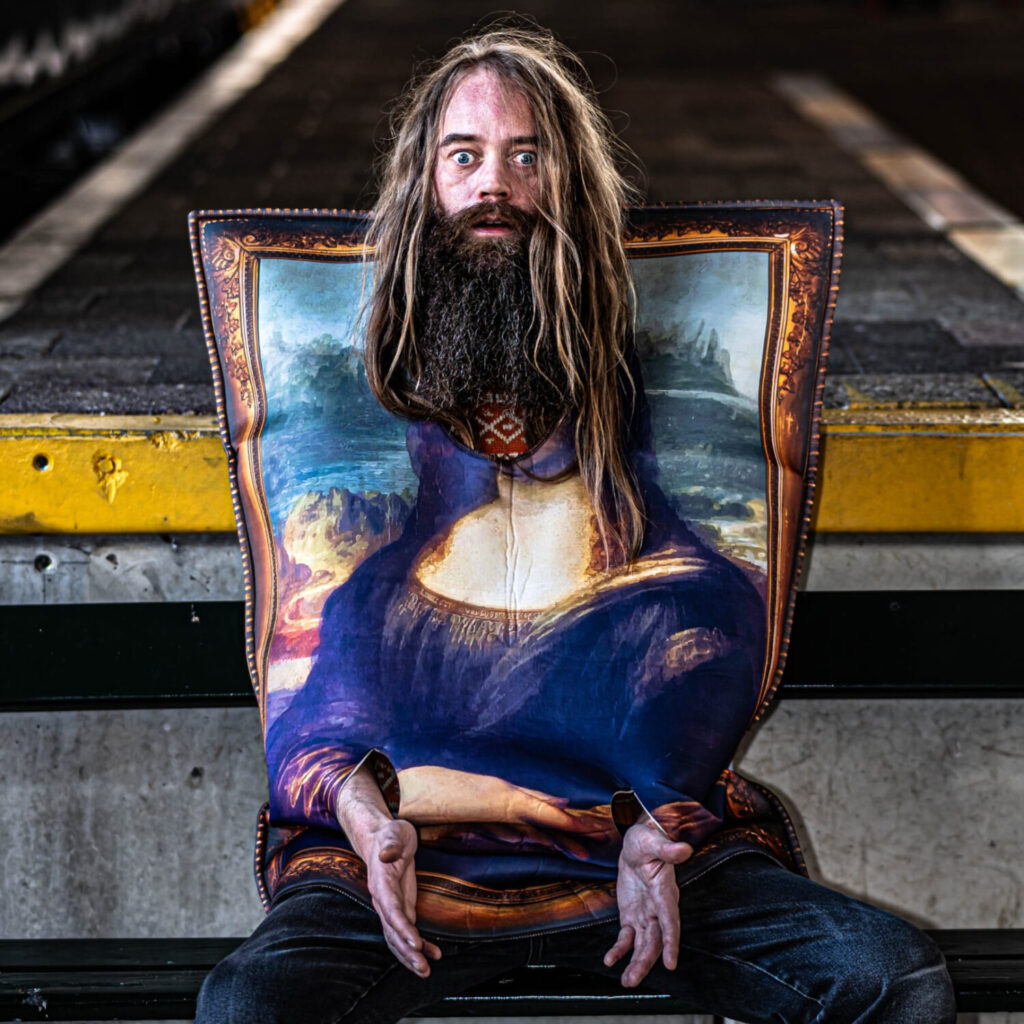
A theological reflection on bona fide aesthetics — the artwork as the incarnation of the divine
In the art world it’s not a secret that the late Andrew Warhola Jr. frequented The Factory as often as the Byzantine Catholic Church; the former with his artistic colleagues and friends, the latter with his mother. Gerard Kornelis van het Reve, the Dutch King (or Queen) of Purple (or Pink) prose, once said: “All art is religious.”
Concrete vs abstract inspiration
Concrete inspiration consists of sense experience, whilst abstract inspiration consists of ideas. In a great work of art, both “forms” of inspiration come together like in the symbol of the cross: the horizontal line represents the historic world of the sensual, the vertical line the eternal world of abstraction. In other words: only in Christianity the Hebrew concept of inspiration comes together with the Hellenistic one.
What exactly is kitsch?
Kitsch art expressions are either too conceptual on the one hand or too sensual on the other. The divine piece of work (a painting, a sculpture or a poem) always has to contain both spirits. Not necessarily in balance or in harmony with each other — genuine art can be utterly disturbing —, but they both have to be there somehow… Therefore the meaning of a great work of art is not really interesting. Absurd ideas and euphoric/hysterical/delusional sense experiences can create lovely works of art. But then again: they both have to be there.
In the flesh
God is, of course, not a thing (he or she is a person, an energy, a will, a force in nature, in history or completely transcendent/supernatural) but every artwork necessarily is. Every artwork is a manifestation of divine inspiration in space, time and matter. But the paradox is this: a great work of art can become timeless and therefore transcend — at least for a while…
Why puritans and fundamentalists always mistrust or even hate art
During times of religious/political upheaval different (re)incarnations of the divine seem like competitions with ‘the real thing’. So it’s not artists who are the problem, but puritans and fundamentalists who make a thing out of the divine. A ‘Fire and Brimstone’ preacher can be a great poet when you can see his (or her) sermons as poems. And from an aesthetic viewpoint they simply are. But the very moment the congregation sees the sermon as a work of art, all authority (propaganda) collapses. This is the reason Jesus of Nazareth never wrote a poem, only a line in the sand.
He was Himself the poem.
Niels Kolman (1984) is a Sunday Poet (zondagsdichter) from North Brabant who mostly writes on Mondays and Thursdays.