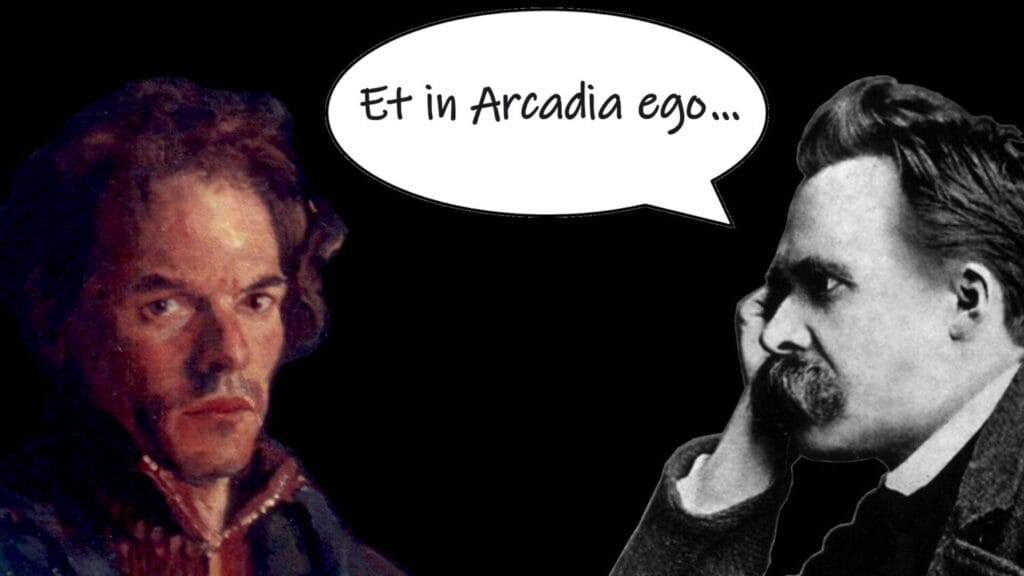
Paul Rhoads and Friedrich Nietzsche : opposites attract ?
We live in interesting and desperate times. The visual arts, and painting in particular, have been diagnosed with illness. Painters look like Hamlet. They just don’t know what to do, let alone what to do with themselves, “out of time” and “out of joint” as they are. And while many a doctor agrees that something is quite wrong with the patient, there’s no consensus on the nature of the illness, let alone the cure.
Focusing on painting, Paul Rhoads offers us an original and headstrong take on its downfall. He throws us all the way back to the Ancien Régime, well beyond the scope of the average art critic. Rhoads’ thesis is as straightforward as they come: ever since the 18th century, painting has been affected by the death of God and the steady rise of a scientific-technological worldview. And if that’s not bad enough, the unbridled belief in our rationality also has political implications. Having decapitated God’s representative on earth, the French revolutionaries launched the idea that we can establish a virtuous society all by ourselves, a paradise in the here and now. Various ideologies have subjected painting to their own agendas ever since, making it a means to an end beyond itself. Much like “eating soup with a fork”, as Rhoads puts it. Once painting became subject to external forces it gradually lost its ‘poetical appeal’ and downgraded to a minor art.
Regarding the ‘Götterdämmerung’, Rhoads cannot help but mention a usual suspect: “a disaffected horse soldier and failed composer suffering from dyspepsia”. One wonders: was this man also equipped with an overgenerous moustache? Ah, then we know who we are dealing with. A failed composer indeed, but what he lacked in musical talent he made up for in writing. Criminally underrated during his lifetime, immensely popular after his mental collapse. Is there anyone across the ideological spectrum who hasn’t claimed Friedrich Nietzsche as a partisan? But perhaps this is what one may come to expect from a Dionysian who rejected wine, from a thinker who stressed the importance of lies whilst praising honesty, from a digger who loved surfaces. It had me wondering: wouldn’t this Nietzschean jack-in-the-box be a great companion to shed some light on Rhoads’ analysis of contemporary painting? Let’s see how far they get along.
“There can be only one”? A tale of two theisms
The notorious death of God. Why do we associate it with Nietzsche’s writings? He certainly wasn’t the first (nor the last) to make this assertion and he’s not exactly a chuckling, self-righteous and self-congratulating atheist either. If anything, Nietzsche is interested in the consequences of God’s eclipse. He wants to gauge the depth of its impact. He knows that quite a few certainties of the past are gone, even though most people will remain unaware. That’s the perspective evoked by the (in)famous passage on the madman who proclaimed the death of God while holding a lantern in broad daylight. The madman causes amusement among “many people standing about who do not believe in God”, in other words: atheists who think it’s “business as usual”. By contrast, Nietzsche invites the free-spirited (a small group of people) not to waste a good crisis. This is not an invitation to become an Overman, which is easily the most misunderstood notion in Nietzsche’s philosophy. Suffice it to say that Nietzsche never conceived of the Overman as an ideal to be actually achieved. He gives a short reminder to those mortals who think otherwise: “The belly is the reason why man does not so readily take himself for a God”.
Anyone who is somewhat familiar with Nietzsche’s work will also notice that it showcases quite a few divinities: Athena, Moira, Apollo and Dionysos. Then it should come as no surprise that Nietzsche praises polytheism for “setting up a prototype of free-thinking”. Wherever there’s multiple gods, deities are individualized: they bring a multitude of norms and perspectives, steering us away from the rigid doctrine of monotheism. Perhaps Nietzsche saw the demise of the biblical God as similar to the downfall of Kronos, the tyrannical titan in Greek mythology. When the latter’s reign ended, his body was cut open and out came the Olympians in all their glory. And doesn’t Rhoads end his latest book (Art in the age of anxiety) with an eulogy on the nine muses of Antiquity, daughters of Zeus? So when it comes to gods and divine creatures, there is room for debate between Nietzsche and Rhoads, even though a Belgian compromise will be wishful thinking.
But it gets even better. Nietzsche and Rhoads have a lot in common when they start ranting about what they dislike in modern society. For one, Nietzsche was never a big fan of the machine age and its utilitarian morality, two outgrowths of that gloomy nation across the channel (perfidious Albion!). In his early work, The Birth of Tragedy, he measured the worth of cultures based on their potential for tragic mysteries, a “healing potion” that goes down the drain when secularization rears its ugly head. Nietzsche takes this expression literally when he discusses what he considers to be Antiquity’s biggest monstrosity: Socrates, the theoretical man, the optimist with the unbridled faith in reason. From this archetypical philosopher to Modernity is but a small step, through our reverence of science. The opposition between science and art is an ‘eternally recurring’ theme in Nietzsche’s thought, culminating in his later works like The Genealogy of Morals, where science has become an avatar of the ‘ascetic ideal’ and thereby a “natural antagonist” of art. It requires little imagination to see striking parallels with Rhoads’ analysis. Here too, we are faced with an opposition between the miracles of modern science and what Rhoads calls “the essence of ourselves, the substance of our humanity”. By that he means our inwardness, our consciousness, our soul and its potential for poetic expression, a capacity threatened by the unstoppable progress of science and its “thaumaturgical toys”. Rhoads couldn’t have said it better than Nietzsche himself: “Since Copernicus man seems to have fallen on to a steep plane […] into nothingness?” But above all, Rhoads will nod in glum agreement with Nietzsche’s assertion that nothing is more corruptible than an artist. If artists have “the big lungs of heralds and the feet of runners” it is because they never stand by themselves but are always in need of a rampart, an authority or a morality to whom they can bend the knee. Rhoads has but to fill in the blanks: modern ideologies ranging from positivism and fascism to Marxism and neoliberalism. If painters are an easy prey for these viruses of the mind, then so is the quality of their work. In short, art and society are in tension. Writing from a minority position, Rhoads even applies a Nietzschean tactic when he states that artists who engage with painting for the love of the artform itself may be seen as “evil ones”, people that don’t fit the sign of the times. And just like Nietzsche saw a great advantage “in estranging one’s self from one’s age” in order to write against it, Rhoads is very much painting against the Zeitgeist. Speaking of painting, let’s see what Nietzsche has to say about this topic.
Painting: the writing on the wall…
It’s no secret that Nietzsche considered music to be the highest artform, but painting is easily his second-best. Nietzsche’s thoughts on the subject are worth examining since they reveal a peculiar evolution which will lead us back to the very heart of the debate with Rhoads. Did Nietzsche not say that man is a measurer, the animal that loves scales and weighing to equate things? Then let’s see how he himself takes the measure of painting.
In Human All Too Human, the first book of his so-called ‘middle period’, Nietzsche is rather sceptical about the use of artistic creations for philosophers. He writes that characters created by artists are not living reproductions of nature, but “like painted men, somewhat too thin”. Artistic creations are “phantasms”, “unnatural simplifications”, the product of the eye that “only sees the surface” of man but remains blind to his “interior condition”. In short, “art is not meant for philosophers or natural scientists”. Portraits have something tyrannical about them: they make us think that the actual person should be just like his or her representation. But already in the same book, this rather negative evaluation is balanced. Nietzsche will not deny the obvious: he knows that art can relieve our life by idealizing its occurrences. Besides, not all is well with philosophers either, judging by the fact that most of them are “metaphysical bird-catchers” who “paint [!] the surrounding world in fewer colors than actually exist”. Having weighed the pros and cons of art and philosophy, what will Nietzsche’s verdict be? Can he achieve a fusion of incompatibles? Is there a common ground between artworks that beautify life but turn it into a fixed object and conscious thought, an interior process with its own deficiencies? In short, can Nietzsche find a synthesis between superficiality and profundity?
The answer comes in The Gay Science, where Nietzsche aims for the best of both worlds. He recants one of his earlier catchphrases (“existence is only justified as an aesthetic phenomenon”) from which he will now draw a very important new consequence. What we should learn from artists is their goodwill to illusion, their ability to make things beautiful and attractive by covering them with a new surface, a blurry skin. Very much like a painter who adds, discards or retouches certain characteristics to complete someone’s appearance. And then, Nietzsche introduces a crucial addendum: “We should learn all this from artists and moreover be wiser than they. For this fine power of theirs usually ceases with them where art ceases and life begins. We, however, want to be the poets of our lives.” And as such, “we also ought to be able to stand above morality”. If existence is only justified as an aesthetic phenomenon, “then we should be able to make such a phenomenon out of ourselves”.
At this point, the fragile alliance between Rhoads and Nietzsche crumbles. If I’ve been ‘painting’ a bit of an “intellectual honeymoon” between both thinkers in the previous chapter, the time has now come to sober up for we have stumbled on the great divide between both men. It’s about the foundation of art, the ‘ground’ on which it operates.
In his book, Rhoads sounds almost Nietzschean when he writes that “from a human perspective, the perspective to which we are condemned, judgments cannot be eluded because things weigh too heavily on our mortal selves.” And if values carry a lot of weight, Rhoads argues that it’s not just because they’re the most important property of the painting process itself, but also because they allow us to determine whether the end result makes for fine art. The purpose of painting is not to teach morals nor to affect the ‘Zeitgeist’ (the pitfall of ideology), but like all great art both the process and the result of painting are to be enjoyed in and for themselves. Up until now, Nietzsche might agree. But then Rhoads makes his conceptual move: just like there can be good and evil in what we like, there is good and evil art. Even though painting can be good as art (in the way in which it is executed), it can still be evil… because it lacks beauty. For Rhoads, true painting is beautiful painting. Beauty awakens the poet and art is what the poet expresses to us about things, about the world. Good art broadens the scope of human expression, it transforms the world as well as our selves by making us conscious of its mystery. And if our consciousness, our inwardness, is what we truly are, then why not conceive that consciousness is also the hidden principle of the cosmos? Hence Rhoads’ preference for depicting religious and mythological stories instead of contemporary events or “the industrial part of our experience”. His work is guided by Eros and beauty, or the desire for transcendence. It strongly resembles a nineteenth century sentimentalist reading of Plato’s philosophy, centered around the Good, the Beautiful and the True.
For Nietzsche, this triad is not a foundation but a Bermuda triangle. He considers art to be guided by the will for deception, a will that sanctifies lying. By contrast, “Plato is the greatest enemy of art which Europe has produced up to the present” because he is the inventor of notions like ‘Pure Spirit’ and the ‘Good in Itself’, gruesome errors that have to be surmounted because the over-appreciation of truth means denying the fundamental condition of life: perspective. If there is only a seeing and knowing from a perspective, then Plato’s abstractions require a ‘non-sensical eye’. Nietzsche sees this tyrannical will to Truth at work in Plato’s thought, in Christian dogma (which he calls “Platonism for the masses”) and in modern science. The latter doesn’t break with the will to Truth, but only with that ideal’s “outer garb or masquerade”. In other words, Rhoads sees a fundamental change where Nietzsche sees continuity, or at least: continuity underneath a mutation. And vice versa: Nietzsche sees a real rupture (between art and metaphysics) where Rhoads wants to lay the foundation of his thinking. And although Nietzsche also emphasizes the importance of beauty, he cannot accept the way in which Rhoads (literally and figuratively) ‘frames‘ it. His perspective is clear: “It is absolutely unworthy of a philosopher to say that “the Good and the Beautiful are one”. If he should add “and also the True,” he deserves to be thrashed.”
Rhoads is not defenseless against these charges. But let us proclaim a ceasefire here and now, for we have come a long way and there are some conclusions to draw.
Open perspectives
Paul Rhoads and Friedrich Nietzsche: two men at odds with their age, especially with its mundane and industrial aspects. Two men with high hopes for a better, more ‘poetically inspired’ future for man… in which elitism plays an important role. Not everyone can become an artist (let alone a painter), just like becoming a higher man is reserved for the happy few. There are undeniable parallels between both thinkers. Perhaps this explains the fierceness of Rhoads’ struggle with Nietzsche. The more an opponent resembles you or the more similarities there are, the more threatening he becomes. When perspectives differ but partially overlap, the argument grows ever more ferocious. Even the soothing environment in which Rhoads lives, evokes a connection with his intellectual ‘frienemies’. Should we be surprised that Nietzsche and Heidegger, two philosophers who preferred the countryside to the city, figure largely in his thinking? And maybe one could even make a similar distinction between artists, between the rural painter (Rhoads) and the urban painter (Tarik Sadouma). Or does this sound all too… “Marxist”?
In The Gay Science, Nietzsche writes how everything that we consider important in a way betrays us: it shows where our motives lie and where they are altogether lacking. When it comes to philosophy though, the plot thickens. Supposing that Truth is a woman, it’s fair to say that philosophers don’t own her but gravitate around her, trying to win her favors. The reasoning of every philosopher is based on blind spots, on presuppositions that are not questioned but taken for granted. Therein lies the frailty and the beauty of every philosophy. Rhoads’ analysis illustrates this wonderfully. There cannot be a shadow of a doubt that he has a tremendous amount of love for painting. Few artists show the same dedication for their craft and its outcome. Rhoads’ reverence underlines the beauty and the weakness of his thinking. He loves painting too much to criticize it too harshly, to condemn it in such a way that its current crisis, its sickness, is attributed all to itself. He will of course not deny the obvious: painters have brought painting down. But these artists only did so because they fell prey to larger societal forces. Rhoads offers us a tale of god(s), secularization, science, revolution and ideology. The problem of painting’s decline is a tale of alienation in the strictest sense of the word: as soon as Modernity’s avatars began dominating the artist’s mindset, the artform degenerated. The first cause, the snowball that started the avalanche, came from the outside. Just like Europa, painting was abducted (and whether Europa has now come to like the bull-ride is irrelevant). If “Modernity is a rapist”, as Rhoads states, then we can count painting among its victims. He discards one fundamental question: what if painting’s crisis isn’t the result of external elements but a symptom of a sickness from within the figurative arts? Rhoads is right to make his way back to the 18th century. He has taught us to dig deep. Now we must become relentless.
We must dig relentlessly.
Nukem 101 – A creature from the underground. One of the worst of a bad lot. Fast, hard to kill and able to either burry or resurrect the dead. A parasite living in the bowels of philosophers, but if they’re strong enough they won’t mind. Enough said.